








-Welcome to our world- the real world of Farming and Agriculture in South Africa- Local and International news- (Farmingportal.-168,260 hits per minute)
 This AGRI NEWS RUSH - Just that one Step Ahead -Some of the news stories of this week-, SUNDAY EDITION - ALWAYS ON TIME - AGRI NEWS RUSH is now one of the most read Articles on a Sunday
AGRI NEWS RUSH - HEADLINE NEWS OF THE WEEK - www.agrinewsnet.co.za
As South Africa heads into the 2026/27 summer season, farmers are urged to prepare for El Niño, which is expected to persist with below-normal rainfall, higher temperatures and increased drought risk, according to the SA Weather Service and Department of Agriculture.
South Africa’s wheat industry stands at a crossroads, with decisions taken on farms today affecting nearly every household. Wheat products are consumed by about 96 % of households and make up roughly 12 % of the average food basket; some 90 % of the population regularly relies on wheat-based foods, with bread accounting for about half of household spending on these products.
Although farmers anticipate a drier season under El Niño and remain concerned about US tariffs together with rising fuel and fertiliser costs driven by geopolitical tensions, investor and farmer sentiment stays optimistic.
AgriSA en die Landbou-Sakekamer vra meer landbouhandel tussen Brics-lande. Hulle voer aan laer tariewe en minder handelsprobleme sal Suid-Afrikaanse boere en ondernemings help om meer markte te bereik en voedselsekerheid te versterk.
The 2026 NAMPO Cape Harvest Days wrapped up this past week from 9 to 12 September at Bredasdorp Park in the Overberg. Held under the theme Together We Grow, the show is the winter grain region's premier agricultural event and the Western Cape edition of the NAMPO brand.
The global ginger market is showing mixed signals as demand recovers after a quieter summer. In Europe, shrinking Chinese and Thai stocks are tightening supply while stricter phytosanitary rules linked to Ralstonia continue to restrict Peruvian shipments
Wheat farmers should not wait for the state to protect them against cheap imported wheat, but accept they will increasingly compete with cheap Russian and Eastern European wheat on the local market and adapt their production strategy accordingly.
South African farmers are facing growing pressure on profitability and sustainability from foot-and-mouth disease, rising input costs and higher labour expenses, leading to calls for greater unity in organised agriculture.
Gauteng’s Agriculture and Rural Development MEC Vuyiswa Ramokgopa has called for government to become a key buyer of food produced by the smallholder and emerging farmers it supports.
A recent column celebrating a decade of anti-dumping tariffs on imported chicken is criticised for ignoring who has paid for that protection: millions of households for whom frozen chicken portions are the cheapest source of animal protein.
Graanpryse het sterk teruggesak namate fondse wins neem, met Vrydag se WASDE-verslag wat as moontlike volgende drywer gesien word. In varsprodukte het uiepryse tot 176% bo verlede jaar se vlakke gestyg en tamaties binne ’n week met 25% gestyg, alhoewel daar tekens is dat die mark kan draai.
Transnet spent 85% of its R23.3 billion capital investment in 2025/26 on replacing and refurbishing existing assets, with only 15% on expansion, CFO Nosipho Maphumulo said at the group's annual results on September 10.
South Africa plans to strengthen economic cooperation with BRICS members at the 18th BRICS Summit in New Delhi on 12-13 September, according to a 9 September statement from President Cyril Ramaphosa's office.The focus will be on expanding intra-BRICS trade and investment, promoting industrialisation and value addition, and mobilising investment in African infrastructure.
Agricultural theft has become a serious threat across the entire value chain, targeting livestock, grain, vegetables, diesel, fertiliser, chemicals, medicine and seed. While stock theft and farm attacks often dominate attention, production and input theft is far wider and undermines farm sustainability as well as national food security.
In a month, the eastern regions of South Africa will begin summer grain and oilseed plantings, mainly of yellow maize and soybeans. Soil moisture is good in these regions after a longer summer rainfall period that continued through mid-May, reinforced by the recent rain and snow experienced across various parts of the country.
Grain prices hit their highest levels in three years in August while sugar prices reached a one-year peak, driven not by poor harvests but by markets pricing in risks from conflict, climate shocks and trade disruptions.
Dr. Theo de Jager, voorsitter van Saai, het op TLU-SA se eiendomsregkonferensie by Nampo Kaap gesê die landbou moet meer as net ’n standpunt oor onteiening sonder vergoeding hê en ’n konkrete plan en strategie ontwikkel vir wanneer ’n boer se grond geteiken word.
South Africa's wheat industry is at a crossroads, and what happens on farms affects almost every household.That was the message from Agri in Conversation: Winter Grains at NAMPO Cape.
IWSR data shows Sub-Saharan Africa’s beverage alcohol market grew 1% in 2025, driven by RTDs (up 11%), spirits (up 6%) and beer (up 1%), while wine volumes fell 3%. The research firm forecasts overall volumes will expand at a 2% compound annual growth rate through 2035, supported by youthful populations, rapid urbanisation and growing middle-income groups.
If you are using our content in your media coverage or on any agricultural radio programme, we would greatly appreciate it if you could credit the source. We understand how valuable and convenient this information can be—especially on a Monday morning after a weekend of NO WORK .
- Weaner calf (live weight): R49.36/kg
- A2/3 carcass: R66.79/kg
- B2/3: R59.39/kg
- C2/3: R57.55/kg
- Feeder / store lamb (live weight): R55.40/kg
- A2/3 carcass: R107.62/kg
- B2/3: R83.41/kg
- C2/3: R81.12/kg
- Porkers: R28.96/kg
- Baconers: R28.64/kg
Exact weekly ex-abattoir figures for early September are less widely published in the latest summaries, but August averages and early-September trends placed frozen whole birds around R31–R32.50/kg, fresh around R34–R35/kg, and IQF portions near R30–R32/kg, with retail chicken averaging about R70/kg.These levels continue to reflect residual FMD-related supply constraints in the red-meat sector (supporting firmer weaner and carcass prices) alongside seasonal patterns and recovering pork and poultry availability. Prices remain elevated relative to pre-FMD periods but show some stabilisation compared with mid-year peaks.

- White maize (WMAZ) September 2026 contract: approximately R3 970
- Yellow maize (YMAZ) September 2026 contract: approximately R3 974
- December 2026 white maize: around R4 138
- December 2026 yellow maize: around R4 128
- Soybeans: approximately R8 762
- Sunflower seed (SUNS) September 2026: R10 100 (notable daily gain)
- December 2026 sunflower: around R10 296
- September 2026 contract: approximately R6 143
- December 2026: around R6 191
50 Key South African Headline News Stories in Agriculture, Farming & Agritech 11 September 2026
-
Agribusiness Confidence Index rebounds 8 points to 53 in Q3 2026 after two quarters below neutral.
- Record commercial maize crop estimated at 17.4 million tonnes, the largest on record.
- By late August, 14–14.4 million tonnes of maize already delivered to commercial silos.
- Soybean deliveries reach 2.8 million tonnes (94 % of the 3.01 million tonne estimate).
- Sunflower seed deliveries stand at 819 101 tonnes (93.6 % of the estimated crop).
- White-maize deliveries total 7.95 million tonnes (89 % of estimate); yellow maize 6.08 million tonnes (87 %).
- Crop quality remains excellent: over 91 % of both white and yellow maize graded Grade 1.
- South African Weather Service warns of strengthening El Niño expected to bring drier, warmer conditions through the 2026/27 summer.
- Department of Agriculture issues El Niño advisory urging climate-smart practices and risk-reduction measures.
- Favourable residual soil moisture from the extended 2025/26 rains is expected to support early plantings despite the El Niño outlook.
- Summer-grain plantings in eastern regions scheduled to begin from mid-October 2026.
- Wheat plantings fall to 479 500 ha, the lowest area in 13 years.
- First 2026/27 winter-wheat production estimate set at 1.8 million tonnes, down 8 % and the lowest in eight years.
- Western Cape wheat crop reported in poor condition after drier-than-usual winter.
- Global wheat-price rise arrives too late to influence South African planting decisions.
- Agricultural exports reach a record US$4.1 billion in Q2 2026, up 10 % year-on-year.
- First-half 2026 agricultural exports total US$7.8 billion, up 11 % from the same period in 2025.
- Shipments to the United States rise 56 % from Q1 as the effective tariff rate declines.
- Egypt concludes Veterinary Health Certificate negotiations, opening its market to South African red meat.
- More than 23 million FMD vaccine doses imported; commercial dairy cows fully vaccinated with first dose.
- Private-sector vaccination of cattle now permitted after earlier state monopoly lifted.
- North West province reports no new FMD cases for the first time since December 2025.
- GroundUp investigation details long-term collapse of the FMD protection-zone system around Kruger National Park.
- Dairy farms alone have lost well over R1 billion to the ongoing FMD epidemic.
- Industry organisations meet the Director-General of Agriculture to discuss Rift Valley fever preparedness.
- South Africa may need up to 20 million Rift Valley fever vaccine doses ahead of the next expected outbreak cycle.
- Agbiz and Agri SA push for deeper agricultural trade facilitation within BRICS markets.
- Grain SA continues to criticise the unchanged wheat tariff reference price of US$279/t.
- JSE soya-bean location-differential dispute escalates; Grain SA estimates potential R700 million impact.
- Stock-theft statistics show 25 606 cases and roughly 190 000 animals lost in 2024/25, with only about 30 % of incidents reported.
- Production and input theft (grain, diesel, fertiliser, seed, chemicals) identified as a growing threat across the value chain.
- Absa AgriTrends notes South Africa enters 2026/27 from a position of relative strength thanks to record harvests and improved grazing.
- Capital-investment sub-index of the Agribusiness Confidence Index jumps 29 points despite weak tractor sales.
- Export-volume sub-index rises 21 points, reflecting strong horticulture and field-crop performance.
- Minister of Agriculture confirms ongoing engagement with National Treasury and amendments to the Animal Health Act.
- Private–public partnership model for FMD vaccination praised for accelerating vaccine rollout.
- Concerns persist over lingering FMD market distortions and incomplete herd recovery.
- High input costs (fertiliser up sharply earlier in the year) remain a pressure point ahead of new plantings.
- Geopolitical tensions and shipping-route risks continue to influence fertiliser and energy costs.
- BFAP Baseline 2026 stresses export-led growth, infrastructure and animal-health reform as critical to 2050 outlook.
- Record summer grain and oilseed harvest (around 21 million tonnes) expected to support third-quarter economic growth.
- Carry-over maize stocks projected to leave South Africa well supplied into a potentially drier year.
- Farmers urged not to expand planted area unnecessarily and to prioritise drought-tolerant cultivars.
- Water-harvesting and drip-irrigation practices recommended as risk-reduction measures.
- Industry warns that any further dry conditions could affect both late main-crop stages and the following season.
- Traceability and formal marketing improvements highlighted as priorities in smaller producer countries supplying South Africa.
- Property-rights conference at Nampo Kaap focuses on expropriation risks and the need for concrete farmer strategies.
- Agricultural organisations emphasise the value of bodies prepared to confront government on policy threats.
- New agricultural-management-plan requirements under conservation legislation flagged as a potential burden on family farms.
- Overall sector narrative: closing a season of abundance while preparing for a more challenging 2026/27 under El Niño and residual animal-disease pressures.

READ MORE ( Stats) Listen to all our Daily Audiocast - It is doing very good. But also see that some news mediums like to follow us.
MORE GOOD NEWS - AUDIO AGRI NEWS NET which was selected by Million Podcasts as one of the Top 100 Agriculture Podcasts, Top 100 Farming Podcasts and Top 100 Sustainable
Agriculture Podcasts on the web. READ MORE
- Free State: 100.5 % (slight rise from 100.4 %). Gariep Dam (South Africa’s largest) at 100.3 %, Vanderkloof at 99.7 %, Bloemhof above 109–110 %.
- North West: around 103 %.
- Gauteng: 100.3 %.
- Limpopo: approximately 98–100 %.
- Mpumalanga: 98.6 % (slight improvement).
- Eastern Cape: around 91 %.
- KwaZulu-Natal: lower than the interior average (high 80s range in earlier readings).
- Western Cape: the clear outlier at roughly 75–80 % overall. Cape Town’s six major supply dams stand at about 75–77.7 %, well below the same period last year. Theewaterskloof is near 76 %, with some smaller dams lower.
The Integrated Vaal River System (critical for Gauteng) remains strong at approximately 97.7 %. Major dams such as Vaal, Gariep and Bloemhof continue to operate at or above full supply level.
Most of the summer-rainfall interior is still near capacity after the extended wet season, providing a solid buffer heading into the 2026/27 summer. The Western Cape (winter-rainfall region) has not filled as strongly and is already seeing declines; officials are monitoring the situation closely ahead of the hotter, drier summer months and possible El Niño effects. Water users nationwide are urged to continue conservation practices despite the currently favourable national picture.

Active outbreaks persist in most provinces. Free State recently reported 191 active cases (of 795 total recorded), with new confirmations in several municipalities. Nelson Mandela Bay in the Eastern Cape continues to see spread, including into township areas, raising concern for nearby dairy regions. North West recorded its first week without new cases since December 2025, signalling local progress. Earlier official tallies (mid-2026) showed more than 2 400 open outbreaks nationwide, concentrated in Free State, North West, Eastern Cape, KwaZulu-Natal, Gauteng and Mpumalanga.
Significant acceleration has occurred under Minister Willie Aucamp (appointed end-June 2026). Approximately 23–23.5 million vaccine doses have been imported (mainly from Argentina’s Biogénesis Bagó and Turkey’s Dollvet), with more than 95 % state-financed. All commercial dairy cows (over 1.38 million animals) have received at least a first dose, and booster campaigns are under way. Private-sector importation, distribution and on-farm vaccination were legalised in July 2026 after a settlement ending the previous state monopoly. Farmers can now register via an online portal to become authorised vaccinators under veterinary oversight. Industry leaders note substantial progress in access and coordination, yet stress that vaccination remains voluntary—the single biggest remaining operational risk. Calls for mandatory measures continue.
The epidemic stems from the long-term collapse of the traditional protection-zone system around Kruger National Park (carrier buffaloes). Failures in dip-tank monitoring, movement control and laboratory capacity allowed the virus to escape into the former free zone from 2019 onward. A 2022 task-team report already described the national animal-biosecurity system as broken; the current crisis has confirmed those findings.
South Africa has lost its FMD-free-without-vaccination status. The sector is transitioning toward an FMD-free-with-vaccination approach. Export markets remain restricted, domestic livestock prices are elevated, and supply chains continue to experience distortion. Red-meat and dairy organisations emphasise that biosecurity, traceability and sustained herd immunity must now become routine.
Government and industry cooperation has improved markedly since mid-2026, vaccine supply is no longer the primary bottleneck, and some provinces show stabilisation. However, incomplete coverage, voluntary uptake, residual movement risks and the need for boosters mean the disease is not yet under full control. Authorities and industry bodies continue to prioritise mass vaccination, stricter biosecurity and restoration of international market access.

DISCLAIMER
The views and opinions expressed in this program are those of the writers and do not necessarily reflect the views or positions of any entities they represent. The information contained in this website is for general information purposes only. The information is provided by CRA and while we endeavour to keep the information up to date and correct, we make no representations or warranties of any kind, express or implied, about the completeness, accuracy, reliability, suitability or availability with respect to the website or the information, products, services, or related graphics contained on the website for any purpose. Any reliance you place on such information is therefore strictly at your own risk.Just for your information. - We need to share this as this is part of Farming and Agriculture.
AGRI NEWS NET stands as South Africa’s leading source for farming and agriculture news, delivering trusted, up-to-date content 7 days a week, 365 days a year. With over 50 “good news stories you can trust,” the platform is driven by 30 years of practical farming and media experience, ensuring a deep understanding of the needs and realities of farmers and the agricultural sector. AGRI NEWS NET prides itself on being committed, independent, focused, and always on time. As part of the CRA Group, the platform leverages its extensive expertise to provide reliable, farmer-centric news. Its content is compiled using advanced AI technology, ensuring accuracy and relevance while staying connected to the broader global farming and agriculture community. For the third consecutive year, AGRI NEWS NET’s Daily Audiocast has been ranked among the top 15 agricultural podcasts on Feedspot, a testament to its quality and impact. The audiocast delivers concise, engaging updates, making it a go-to resource for farmers, industry professionals, and agriculture enthusiasts seeking timely insights. With a focus on “good news stories,” AGRI NEWS NET highlights positive developments, innovations, and successes in South African agriculture. Rooted in real-world farming knowledge and media expertise, AGRI NEWS NET bridges the gap between farmers, policymakers, and the public. Its AI-driven platform ensures comprehensive coverage, from local issues . By focusing on practical, trustworthy content, AGRI NEWS NET empowers the agricultural community to stay informed and inspired.

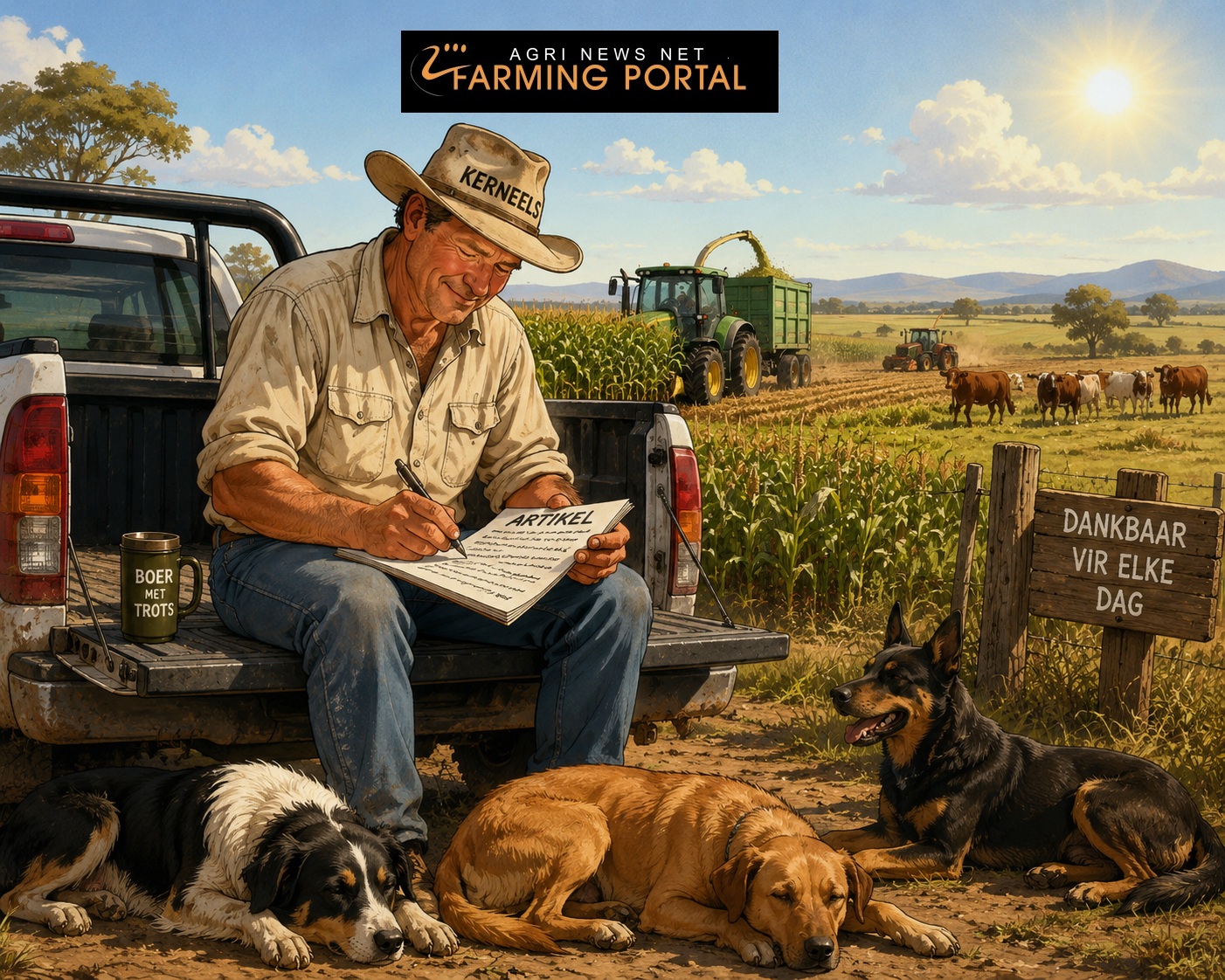
OOM KERNEELS
Van die Plaas af:
Die weer hier in die Vrystaat is sommer klaar deurmekaar. In 'n baie kort rukkie se tyd kry van ons mede-boere 140 mm reën - dis baie water. En jy weet, my oorlede oupa het gesê dat as die reën eers sy streep gemaak het in 'n sogenaamde El Niño-jaar, dan bly dit daar reën, en ander plekke is vetkolle. Nou sien ek dat ons weer reën gaan kry - dis baie goed. Ons is besig met die voorbereiding van die lande en ons pas elke druppel diesel op - dit is iets wat baie maklik gesteel word.
En so vat ek en Gertruida die pad af Nampo Kaap toe - soos altyd lekker gestop en sommer lekker padkos geniet. Ons het darem 'n slaapplek gehad naby Bredasdorp - moet jou sê, ek sal nie kan ploeg of plant in daardie klipwêreld nie.Heerlik gekuier by al die bekendes daar by Nampo, en ook ons edele minister ontmoet - gawe man, en baie gewild onder die boere. Jy kan sien hy praat nie baie nie - 'n ware doener. Dis wat ons nodig het - ons het te veel praters.
Ek het so 'n rukkie teen my sin gesit en luister na die hooggeplaastes en korporatiewe manne se geselssies oor boere en landbou, wat sekerlik interessant is, maar daar was nie veel wat my opgeval het nie. Ek moet my eie potjie krap- en praat is goed, maar dan moet dit oorgaan tot aksie.
As ek so deur my foon blaai, dan sien ek baie onderhoudsprogramme oor landbou en sou graag wou weet wie kyk daarna - want ek het nou al oral rondgevra en almal sê nee. Die meeste van die mense weet nie veel daarvan nie.
Afgesien van alles was Nampo heerlik goed, georganiseer en dis lekker om so tussen my eie mense te wees. Getruida het weer 'n paar kaggel goetjies gekoop wat volgens haar eksklusief is. Sy het darem my gehelp bestuur.
Skelm is wat ons elke dag ervaar in hierdie mooi land van ons- Nou lees ek dat die OBP ons boere weer wou melk met die entstof vir bek en klouseer--- maar daar gaan nog baie stories uitkom.
Die jaar wat kom is 'n groot kommer en ons moet net hierdeur - ons is al deur baie jare, maar die banke is nie meer so vrygewig soos altyd nie, hulle beheer jou nou. Koring is groot probleem en ons boere kan nie aanhou plant onder die omnstandighede nie.. Brood is stapelvoedsel en die regering gaan nie byt nie.
Ek probeer so nou en dan televisie kyk op Herhaal-net (KykNet), maar die-advertensies is sleg op 'n mens se sisteem. Hoeveel keer moet mens nog hoor van goedkoop premie of iemand wat eet soos ek nog nooit geeet het nie.
Die nuus is net kaping, doodslag en moord.Vir eers het ek nou genoeg gehad van rugby - ons sien die Springbokke is tops, maar nou is dit te veel. Daar is ook ander dinge wat in die wêreld gebeur. E
Met ons terugkom van die Kaap gister was dit darem lekker om weer in jou eie bed te slaap en die Vrystaat se lug in te kry. Dankbaarheid is een van die grootste dinge wat jy elke dag moet hê... en dit moet natuurlik kom.
Groete uit die Vrystaat
Tot volgende week.
Mag julle almal ’n lekker week he ons gesels weer. OOM Kerneels.

NS -We normally do not post sponsored or external videos on our professional platforms. However, videos of this nature — which are non-marketing and informative — are not freely available YouTube channels. We will soon have our own Professional Video Channel form our own Production house.