








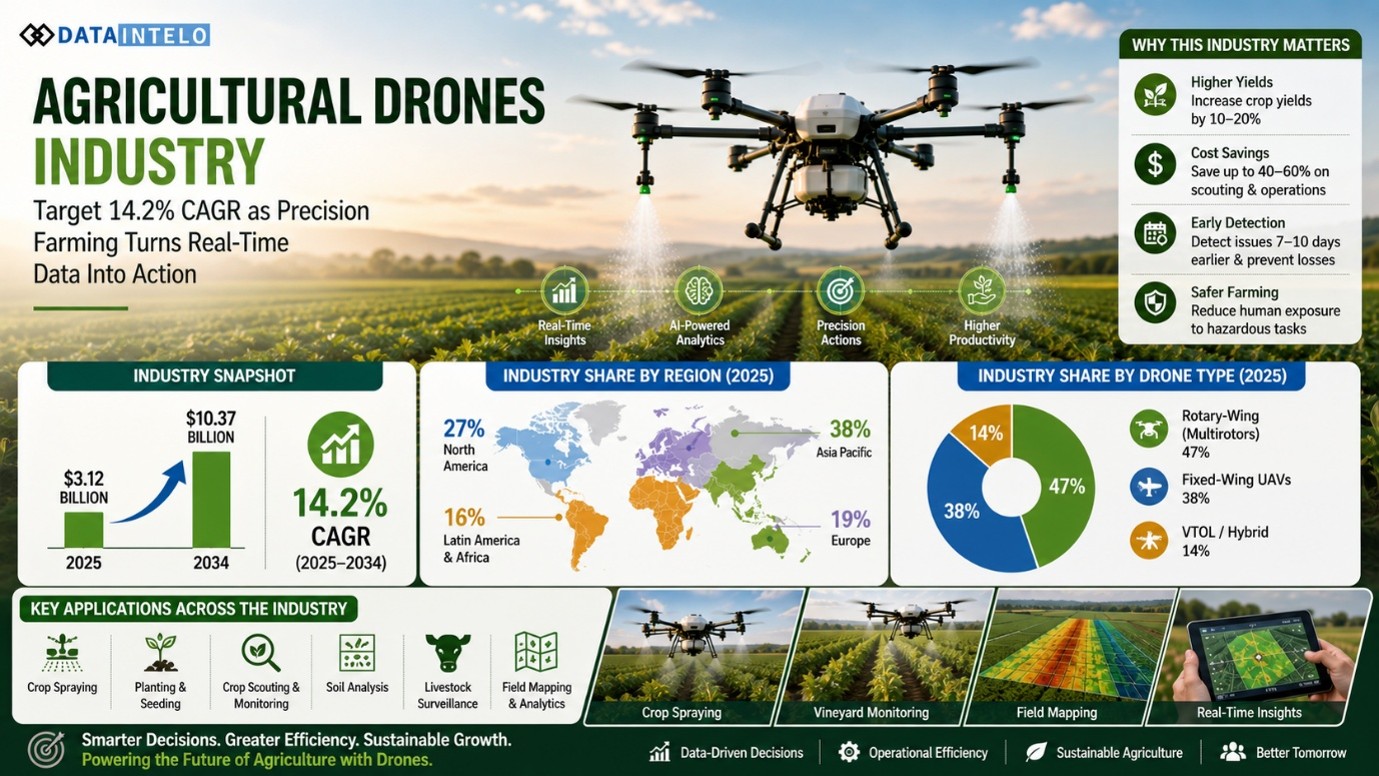
. The amount of investments into this sector will grow from $3.12 billion in 2025 to $10.37 billion in 2034, meaning CAGR of 14.2%. These trends are explained by increasing use of drones in precision agriculture. Nowadays, the types of agricultural drones consist of not only fixed-wing drones for survey of large territories but also multirotors for more specific purposes called "flying tractors." High-quality sensors including multispectral, thermal and LiDAR sensors in combination with AI analysis allow these drones to give instant information about the crops that could not be obtained before. As for the leaders of agricultural companies, this technology helps them to make decisions based on data regarding planting, spraying and watering of their fields.
Outlook: Scale, Geography, and Sectors
This success story is fueled by strong drivers within all geographies. Currently, Asia Pacific is at the forefront of drone technology implementation, claiming almost 38% of 2025 revenues. The governments in China, India, and Japan are pushing agricultural automation in order to ensure the food supply security, while small farmers in these regions already widely use drones to spray and track rice and other crops. North America takes second place with 27% share where corn and soybean producers use drones for scouting and precise applications. Europe comprises about 19% of the market where Germany, France, and the Netherlands lead in data-driven agriculture and organic farming. Latin America and Africa, representing about 16% of the total market, are still at an early stage of development, with pilot projects implemented in Brazil (sugarcane and soy), Mexico (avocado), and sub-Saharan nations..
According to product type, rotary-wing drones, also known as multirotors, account for more than 47%, and fixed-wing UAVs take up almost 38%. Rotary-wing drones have a high degree of maneuverability and vertical takeoff capability and hence are well-suited for orchard or vineyard sprays. On the other hand, fixed-wing UAVs are gaining popularity rapidly due to the high number of acres that they can cover within one flight and hence are used increasingly by large-scale farms in the US, Brazil, and Australia. VTOL/fixed-wing hybrids constitute 14% of the market and are expected to grow near 16% CAGR. In terms of application, drones are now being used not only in crop-spraying but in planting, seed distribution, soil analysis, and animal surveillance.
Precision Farming and Return on Investment
Drone technology is not only an advanced agricultural innovation but a profitable tool for farmers and other people involved in farming. Frequent missions provide information which leads to the optimization of the process of fertilization and application of pesticides and herbicides. For example, using drones to conduct variable-rate fertilization or application of pesticides increases yields of corn, wheat, and soybeans by 10-20%. Detection of pests or plant stress conditions seven to ten days before the appearance of symptoms gives the opportunity to control the situation and prevent any losses. Drift reduction in spraying and mapping and reduced scouting costs because of the implementation of drones allow to save up to 40-60% of expenses for field scouting and make the investment in drones paid off within two-three years in case of farms of more than 500 acres.
Practically, drones are referred to as “flying tractors.” High-grade sprayer drones can be loaded with up to 220 lbs (or about 100 kg) of chemicals per trip, treating 10 to 25 acres in one hour. The production is similar to that which could be done by 30 to 100 workers carrying out their work on foot with backpacks. Traditional scouting operations on farms cost between $3 and $5 per acre per visit, hence one drone operation equals a huge amount of labor costs. By taking away some of the dangerous or boring work from the farmers, drones have increased the safety of the farmers as well as helped attract youth to the field.
Trends in Adoption and Case Studies
The rate of adoption of drones in agriculture continues to increase, though at different paces depending on location. China leads clearly: having launched its first ag-specific quadcopter back in 2016, it has 250,000+ agricultural drones operating now. DJI, alone, delivered over 700,000 agricultural drones globally to China and 100+ countries by mid-2026 – an increase by five times within five years. Chinese farmers actively use drones for sowing, spraying, and even transporting cargo over flooded or difficult terrains, with 17 million tonnes of cargo flown last year. In Thailand, the speed of adoption was also impressive: as of 2023, 30% of the country's farmland received drone spraying services, compared to virtually zero in 2019.
In the US too, adoption is picking up pace. As per records with FAA, registrations of US agricultural drones soared from approximately 1,000 in January 2024 to about 5,500 mid-2025, though the actual number must be higher because of non-registration by smaller players. Farmers in the US use drones in corn and soybean crops for scouting for disease and weeds in areas that cannot be reached by man. The region is younger than Asia in terms of this technology, but there are increasingly more studies of pioneers, ranging from Midwest grain farms doing weed mapping to California vineyards using thermal drones for monitoring their irrigation. In Australia, roughly 10% farmers use drones, with 8,000-24,000 units expected to be in use by 2040.
Latin America and Africa lie even further ahead of the adoption cycle. Drone spraying and monitoring have proven to provide savings in costs and productivity for Brazilian coffee, soy, and sugarcane producers, delivering an ROI period of 1–2 years for large-scale commercial production. In Africa, the use of drones in conjunction with government-funded precision agriculture initiatives supported by international aid organizations is becoming common practice in countries like Ghana, Ethiopia, and Kenya.
 New uses for agriculture drones and their data
Regulatory and Industry Context
Emerging regulatory schemes are facilitating this growth. Aviation regulatory bodies across the world are being more aggressive with regard to allowing commercial drones to fly. The US FAA has made it mandatory for most drones over 250 grams to be registered and broadcast Remote ID. New Part 137 rules have also made it easier for unmanned aerial systems that apply chemicals to become certified, and hundreds of US operators have received waivers and certificates.
The European Union's aviation agency has standardized drone regulations since 2021, with an EU mandate from January 2024 that all higher-risk drones in the union have to transmit their identity and register nationally, while a lower Remote ID weight of 100g is being considered, in line with UK legislation passed in 2026. In addition, countries like Brazil, India, and Australia have increasingly relaxed UAV usage in agriculture because of its value in production and food security. This spells fewer regulatory risks for business executives, whose compliance burden is lightened by clear regulation.
In terms of supply, there are only a few major players emerging. In terms of UAVs used in agriculture worldwide, DJI leads the market with over 40%, thanks to its Agras spraying drones and its software suite, along with companies like AeroVironment, Parrot, Yamaha, and Trimble. Such companies are rapidly innovating, equipping their drones with AI chips to detect stress in crops and integrate them with farm management systems, and startups offer data-as-a-service atop drone flights more often than not.
There are obstacles in the industry dynamics, however. US legislators consider placing restrictions on Chinese agricultural UAVs due to DJI taking a big chunk of market share domestically. DJI states that its drones are beneficial for sustainable agriculture and such regulations would be detrimental to farmers. Decision-makers would need to balance national security considerations with practical benefits from current equipment. Besides, in addition to geopolitical factors, battery charging stations, rural broadband networks, and drone pilots training would play an important role in determining the winners in certain regions.
Expert Perspectives
According to agriculture technology specialists, drones represent an "irresistible trend" that is transforming agriculture on a global level. Scholars observe that drones did not follow the typical path of technology adoption – contrary to popular opinion, this technology spread in Asia first, through small agricultural farms before it got adopted in America and Europe, thus providing agriculture in this continent a technological head-start in terms of platforms and adoption procedures. Agronomists suggest that combining information collected by drones with machine learning provides actionable early warning signs such as NDVI anomalies, which signal the occurrence of pest infestations in particular, which are especially helpful when dealing with commodity crops. At the same time, experts warn that many potential benefits are yet to be quantified.
Case studies continue to be positive; large North American wheat and corn farms have seen 10-15% reductions in fertilizer usage along with increased crop production following the implementation of drone mapping and variable rate fertilization techniques, and farmers in Australia using drones to monitor pastures and weeds have calculated that they will reach break-even point within just two years. In one particular study, 85% of executives of farms mentioned rapid decision-making as the main advantage of utilizing drones. Innovations are rapidly emerging, from swarm spraying drones to solar panels being towed by drones for field charging.
Analytics companies are now starting to integrate drone images into larger models, using satellite weather information, ground-based sensors, and repeated drone surveys to make predictions about the season ahead. Analytics platforms offered by companies such as DroneDeploy and Sentera are already tracking drone data along with the harvest data, allowing agribusinesses to determine increases in yield and return on investment for each input down to the individual acre. It is the combination of these different technologies that makes this trend so promising – it is not just the drone flying through the air, but what it does. The value of drone data is already being considered as an important performance metric alongside soil tests and satellite NDVI indices.
Conclusion
Drones in agriculture are shifting from being on the fringe to becoming mainstream in the global farming landscape. At an estimated CAGR of 14.2% by 2034, this area is poised to take the concept of precision farming to new levels of realization. The combination of real-time aerial data analysis and robotization is helping to make efficiency and cost-effectiveness that meet the farm business objectives. As the barriers to implementation diminish and costs remain low, there may be greater acceptance and uptake not only for larger but also medium-scale and even smallholder farms. For senior agricultural business executives, the key challenge is adopting the use of drone data in making decisions in order to remain relevant.
Author Bio -
Ashish Kolte is a Marketing Manager at DataIntelo with expertise in marketing, market intelligence, and business strategy. He combines marketing insights with industry research to analyze market trends, identify growth opportunities, and provide data-driven perspectives on emerging industries and global business developments.