







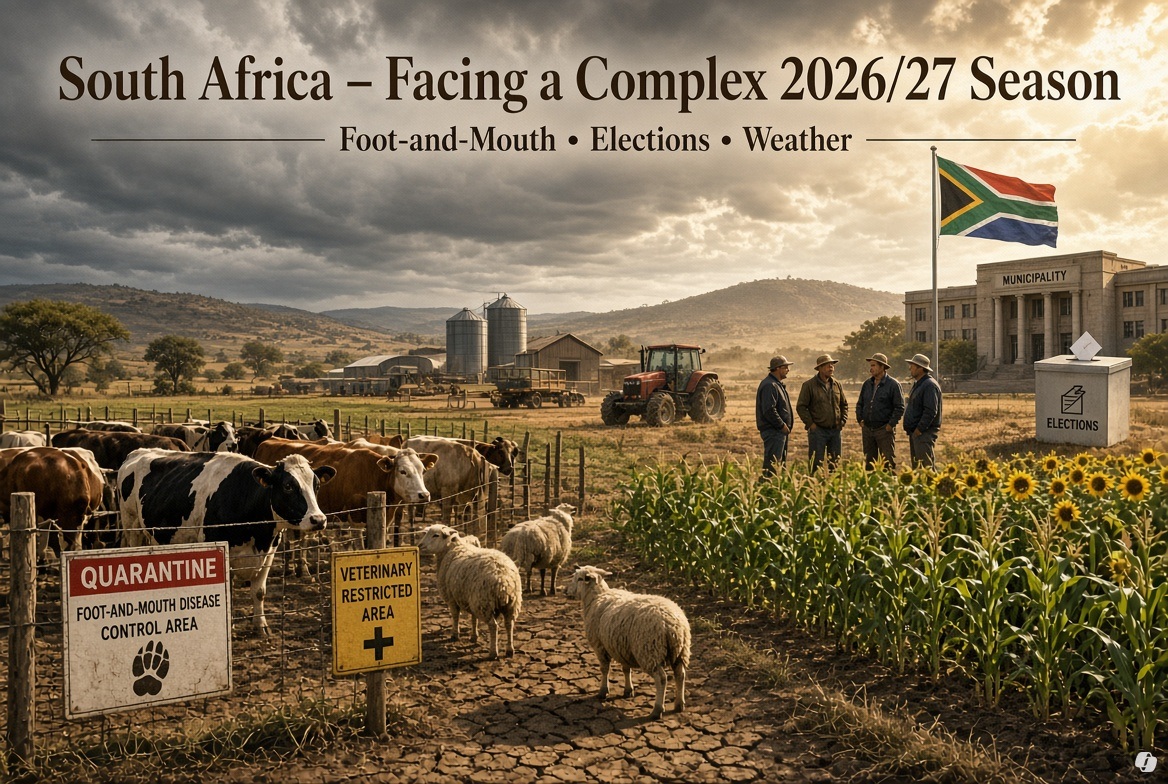
 South Africa -Facing a Complex 2026/27 Season -Foot-and-Mouth,Elections,Weather
 South Africa’s livestock and crop sectors are heading into a demanding period as several overlapping challenges converge. Foot-and-mouth disease continues to disrupt the industry, local government elections loom, international conflict is driving up input costs, and a strengthening El Niño threatens drier conditions for the coming summer season. Farmers and industry stakeholders are watching developments closely as they prepare for 2027 and beyond.The foot-and-mouth disease (FMD) crisis remains one of the most pressing issues facing the livestock sector. Despite ongoing efforts, concern persists about the effectiveness of the current risk-based approach. The new Minister is doing a great job.
Many producers and industry experts are calling for a more coordinated mass vaccination campaign, similar to the successful programmes implemented in countries such as Argentina. Such a strategy, they argue, could bring the disease under control more rapidly and help restore confidence in South African animal health systems.Recent changes have simplified the process for individuals to register as “authorised persons” allowed to administer FMD vaccines themselves. While this move aims to speed up vaccination coverage, some observers worry that the lowered threshold may be too lenient and could complicate South Africa’s efforts to regain official FMD-free status with the World Organisation for Animal Health.
Maintaining strict standards is essential if the country hopes to reopen key export markets that have been restricted because of the disease.The private sector is increasingly stepping in to support control efforts. Companies such as Biogénesis Bagó are supplying vaccine, helping to ease shortages and improve availability. At the same time, there is growing pressure for stronger cooperation between government, private industry and farmers. Calls for faster regulatory adjustments and the establishment of dedicated control rooms — such as the one operating in the Eastern Cape — reflect the need for quicker, more coordinated responses when new outbreaks occur. Without improved collaboration and decisive action, the disease risks remaining a long-term constraint on the livestock industry’s growth and export potential.
 VIEWPOINT- Fertiliser Export Prices and Availability in Focus Ahead of South Africa’s 2026-27 Season
Meanwhile, the political calendar is also demanding attention. Local government elections have been officially set for 4 November 2026. The voters’ roll closed after the final registration weekend, leaving approximately 29 million registered voters. More than 600 political parties are registered to contest the polls. The Democratic Alliance has already launched its manifesto, while the Economic Freedom Fighters has announced plans to field candidates in every ward across the country. These elections are widely viewed as a critical test of municipal service delivery and an indicator of broader political shifts at the local level. For the agricultural sector, the outcome could influence everything from infrastructure maintenance and water management to land administration and support services that farmers rely on daily.On the global front, the ongoing conflict in the Middle East is casting a shadow over the approaching planting season.
Disruptions around the Strait of Hormuz have pushed up the prices of diesel and fertiliser — two of the most critical inputs for grain and other crop farmers. Higher costs arrive at a particularly sensitive time, just as producers prepare for summer planting. Elevated nitrogen fertiliser and fuel prices may force some farmers to reduce application rates, switch to less input-intensive crops, or simply plant fewer hectares. Export-oriented sectors such as citrus are also feeling the effects through higher shipping costs and the need to reroute vessels.
Although temporary diplomatic progress has occasionally eased price pressure, the overall situation remains volatile and continues to squeeze already tight profit margins.Looking ahead to the 2026/27 season, weather forecasts add another layer of uncertainty. A strong El Niño is developing and is expected to persist into the summer months. Historically, such conditions bring warmer and drier weather across much of South Africa’s summer rainfall region, particularly from late spring through summer. While early spring may still deliver mixed or even above-normal rainfall in some areas, the dominant signal for the core planting and growing period points to below-normal precipitation.
Dam levels in several systems are already lower than at the same time last year, reinforcing the need for careful water management. Farmers are being advised to prioritise conservation measures and to adopt climate-smart practices in anticipation of possible drought stress.Taken together, these factors paint a picture of a challenging but not insurmountable period for South African agriculture. Progress on FMD control, careful management of rising input costs, and proactive adaptation to expected dry conditions will be essential. The local elections may also shape the municipal environment in which farmers operate. Close cooperation between government, the private sector and producers, combined with timely decision-making, will help determine how resilient the sector proves in the face of these converging pressures as 2027 approaches.'
In 2027, South Africa’s agriculture and farming sector is expected to face a challenging but manageable year, shaped by the delayed effects of an El Niño-influenced 2026/27 production season, ongoing foot-and-mouth disease (FMD) pressures, elevated input costs, and a continued shift toward export-led growth and productivity gains. The sector is likely to remain more resilient than the broader economy, though margins will stay tight and outcomes will depend heavily on weather realisation, disease control, and policy coordination.