







-Welcome to our world- the real world of Farming and Agriculture in South Africa- Local and International news- (Farmingportal.-168,260 hits per minute)
This AGRI NEWS RUSH - Just that one Step Ahead -Some of the news stories of this week-, SUNDAY EDITION - ALWAYS ON TIME - AGRI NEWS RUSH is now one of the most read Articles on a Sunday
Agriculture Minister-designate Willie Aucamp believes South African farmers are already world-class and do not need excessive state intervention to succeed. He emphasised that government’s role should be to remove red tape and make it easier for farmers to operate.
Standard Bank Group invested R3.45 billion ($208.1 million) in climate-smart agriculture over the past year to help South African farmers improve resilience, productivity and food security amid growing climate challenges. The funding supports initiatives such as water-efficient irrigation, renewable energy projects, regenerative farming practices and precision agriculture technologies
Fertiliser shipments through a key waterway have started to rise again after an interim deal to end hostilities, but volumes remain well below pre-conflict levels and are not yet easing market pressure. Before the conflict began, about a third of globally traded urea and nearly half of seaborne sulphur moved through the strait.
The global apple market is currently influenced by the winding down of Northern Hemisphere stocks and the active Southern Hemisphere export season.
Africa spends about $4 billion a year importing powdered milk despite having tens of millions of dairy cattle across countries like Kenya, Ethiopia, Uganda, Tanzania and Nigeria. In 2024 the continent imported over 900,000 tons of powder, with a handful of North and West African markets accounting for most of it.
Fuel is one of the biggest cost items in grain farming because diesel powers land prep, planting, spraying, harvesting, irrigation and transport. It typically makes up 10–15% of input costs, but the share rises when fuel prices spike. Diesel also pushes up transport, grain handling and input delivery, while energy markets drive fertiliser costs, especially nitrogen made from natural gas.
Ons is in die middel van die jaar, in die middel van die winter, en in die middel van ’n krisis wat al vir jare aanhou. Mense wat oor ons grense kom en maak net wat hulle wil in Suid-Afrika. En intussen dink die regering nog steeds hulle het beheer. Suid-Afrika steek af op ’n politiek gelaaide tydperk. Op 30 Junie beplan groepe soos March and March betogings.
Record-high temperatures are currently being experienced in Europe, partly due to the developing El Niño, and there is a strong chance this could lead to record heat in South Africa from December onward.The U.S. National Oceanic and Atmospheric Administration estimates a 63% chance of a “super” El Niño developing during the 2026-27 summer season.
International crude prices have fallen back close to their pre-Iran war levels,Brent crude now trading around $73 per barrel,decline of 36% from the peak reached during the conflict of $114 per barrel.The move reflects easing supply fears as markets price in the reopening of key Middle East shipping routes, including the Strait of Hormuz,expectations of a gradual return of Iranian exports to global markets.
Graan SA beskou die onlangse koringtariefbesluit nie as net ’n tegniese handelskwessie nie, maar as ’n ernstige waarskuwing vir produsentevertroue, plaaslike produksie, werkskepping en langtermyn-voedselsekerheid.
South Africa’s agricultural markets this week reflect a mix of pressures and opportunities amid rising uncertainty. Grain markets have moved away from war-related concerns and are now driven by weather patterns, price parity, export competition, and the growing threat of a possible Super El Niño.
TLU SA verwelkom landbouminister John Steenhuisen se aankondiging oor die nuwe nasionale beheermaatreëls vir bek-en-klouseer (BKS). Die organisasie beskou die wysigings as ‘n positiewe stap wat groter duidelikheid aan produsente kan bied en erkenning gee aan die groot ekonomiese impak wat langdurige uitbrekings en beperkende maatreëls op die veesektor het.
South Africa’s record 2025 citrus season has cemented its status as the world’s leading citrus exporter, but industry leaders say ongoing gains in port productivity will be essential to maintain momentum. Growers shipped about 203 million 15kg cartons in over 120,000 reefer containers to more than 100 countries this year, according to the Citrus Growers’ Association of Southern Africa.
South Africans are questioning why petrol prices remain high at around R27.95 to R28.06 per litre for inland petrol and R28.50 for diesel, even though Brent crude oil — South Africa’s main benchmark — has fallen sharply to approximately US$73.70–74.10 per barrel as of 26 June 2026.
South Africa’s livestock sector cannot reach its full growth potential by relying only on the local market. The future depends increasingly on exports, better market access, and stronger biosecurity. The ability to position local meat as a high-quality brand in international markets is central to growth for the industry.The domestic consumer market has been under pressure for years.
A report challenges the widely repeated claim that one group owns 72% of the country’s land, calling it inaccurate and misleading. The figure comes from a 2017 land audit that only covered private agricultural land and smallholdings where race could be identified, and that audit had methodological flaws like relying on surnames to determine race, mathematical errors, and unverified sources.
Livestock will return to the Nampo Alfa show this year, taking place on 2 and 3 October at Nampo Park outside Bothaville. Animals will also be part of the 2026 event. The early announcement is important for breeders and exhibitors, since preparing show animals takes months of planning.
The formation of the Government of National Unity has been central to South Africa’s improved investor climate, which has helped strengthen the rand. Without that stronger investor sentiment, the currency would likely have weakened much more during the recent Middle East war and related global pressures.
The agricultural sector recorded a trade surplus of $1.55 billion in the first quarter of 2026, up 16.1% from the same period a year earlier. The stronger performance came mainly from a 10.6% year-on-year decline in agricultural imports to $1.76 billion, while exports held steady at $3.30 billion.
A common claim that one racial group owns 72% of the country’s land is described in a new report by a civil rights organization as inaccurate and highly misleading.According to the report, that statistic, which is often used to justify radical land reform, is based on a flawed 2017 land audit.
If you are using our content in your media coverage or on any agricultural radio programme, we would greatly appreciate it if you could credit the source. We understand how valuable and convenient this information can be—especially on a Monday morning after a weekend of NO WORK .

Summary: Red Meat, Chicken & Pork Prices in South Africa – Last Week of June 2026
South African meat prices remained relatively firm during the final week of June 2026, although trends differed between beef, lamb, pork, and chicken markets.
Beef (Red Meat)
- Beef prices remained supported by strong demand and ongoing production costs.
- Recent retail beef prices averaged around R158.85/kg, slightly lower than earlier months but still significantly higher than a year ago. Beef remains one of the most inflation-sensitive food categories.
- Producer carcass prices for A-grade beef traded around R63–64/kg, indicating a relatively stable market.
Lamb and Mutton
- Lamb prices continued to outperform most other meat categories.
- Strong consumer demand and limited supply kept prices elevated.
- A-grade lamb carcass prices remained above R100/kg, with some markets showing further upward pressure during June.
Pork
- Pork remained one of the more affordable protein options.
- Retail pork prices averaged approximately R129.57/kg, showing modest increases compared with earlier months.
- Demand remained steady as consumers looked for alternatives to more expensive beef products.
Chicken
- Chicken remained South Africa's most affordable animal protein.
- Retail chicken prices averaged around R69.70/kg, showing very little month-to-month movement.
- Broiler prices were mostly stable, supported by adequate supply and lower feed grain prices.
Factors Influencing Prices
Several factors continued to affect meat prices during June:
- Rising labour and transport costs.
- High electricity and logistics expenses.
- Previous increases in diesel prices that pushed production costs higher.
- Ongoing biosecurity concerns in the livestock sector.
- Consumer resistance to further food price increases.
Outlook for July 2026
With diesel prices easing and feed costs showing some improvement, there may be room for price stability in chicken and pork. However, beef and lamb prices are expected to remain relatively high due to strong demand and tight supply conditions. Many farmers argue that while fuel prices occasionally decrease, input costs rarely return to previous levels, placing continued pressure on food production and contributing to persistent food inflation. Chicken remains the most affordable meat choice, pork offers good value, while beef and lamb continue to trade at elevated levels heading into July 2026.

South African grain and oilseed markets remained under pressure during End week of June 2026 as expectations of a large summer grain harvest continued to weigh on maize prices. Oilseeds remained relatively stronger, supported by international vegetable oil demand and steady local crushing demand.
SAFEX Spot / Nearby Prices (23 June 2026)
| Commodity | Price (R/ton) |
|---|---|
| White Maize | R3,140 |
| Yellow Maize | R3,199 |
| Wheat (Bread Milling) | R5,785 |
| Soybeans | R6,871 |
| Sunflower Seed | R8,970 |
Market Highlights
White & Yellow Maize
- Maize prices remained relatively subdued due to expectations of a crop exceeding 17 million tonnes.
- Export competition, particularly in white maize markets, continued to limit upward price movement.
- Ample local supply remains the dominant factor influencing the market.
Wheat
- Wheat traded around R5,785 per ton.
- Prices remained supported by international wheat values and South Africa's reliance on imports to meet domestic demand.
- Currency movements and global Black Sea supply conditions continue to influence local pricing.
Soybeans
- Soybeans traded near R6,870 per ton.
- Local crushing demand remained supportive, although global soybean supplies kept significant price rallies in check.
- Nearby SAFEX soybean contracts traded between approximately R6,865 and R6,900 per ton during the week.
Sunflower Seed
- Sunflower remained the strongest-performing major crop, trading close to R9,000 per ton.
- Strong edible oil demand and firm vegetable oil markets continued to support prices.
- Sunflower prices remained significantly above maize prices, maintaining attractive margins for producers.
Outlook Heading into July 2026
The market is expected to remain influenced by:
- Large South African maize supplies.
- Export demand opportunities.
- Exchange rate movements.
- International grain and oilseed markets.
- Fertiliser and diesel costs ahead of the 2026/27 planting season.
As June 2026 came to an end, maize prices remained under pressure from abundant supplies, while soybeans and sunflower seed continued to show greater resilience. Wheat remained relatively stable, supported by import parity considerations and global market developments.

30 Key South African Headline News Stories in Agriculture, Farming & Agritech as of Friday, 26 June 2026:
Here is a curated list of the most important recent and ongoing stories:
- South Africa’s Agricultural Sector Grows 3.9% in Q1 2026 Despite Multiple Challenges
- Agricultural Exports Surge 11% to $3.7 Billion in First Quarter of 2026
- Foot-and-Mouth Disease Crisis Deepens in Free State with 634 Confirmed Cases
- 14 New FMD Cases Reported in Free State This Week
- Government Secures Additional FMD Vaccine Supplies as Inoculation Drive Accelerates
- Strict Biosecurity Protocols and Movement Restrictions Extended in FMD Zones
- Minister Steenhuisen: Agriculture Continues Strong Performance Despite FMD and Trade Pressures
- Winter Rainfall Region Faces Reduced Rain Outlook for Second Half of Season
- Cold and Wet Conditions Persist Across Western, Central, and Southern SA
- Western Cape Dam Levels Improve Marginally to 74.69%
- Clanwilliam Dam Rises to 90.65% Amid Calls for Continued Water Savings
- Summer Grain Harvest Delayed by Persistent Wet Conditions and High Humidity
- Global Fertiliser Trade Drops 30% Due to Gulf Conflict and Strait of Hormuz Disruptions
- Rising Fertiliser Prices Raise Input Cost Concerns for 2026/27 Summer Crop Season
- Agbiz Congress 2026 Highlights Resilience and Need for New Market Access
- El Niño Signals Raise Drought Concerns for Late 2026 Growing Season
- Farmers Urged to Prioritise Soil and Water Conservation in Winter Crop Areas
- Record Canola Harvest Achieved in 2025/26 Despite Challenges
- Rooibos Exports Reach All-Time High in 2025
- Vineyard Automation Gains Traction as Labour and Cost Pressures Mount
- AI Technology Increasingly Explored to Boost South African Fruit Export Industry
- Drone Technology Adoption Accelerates Among South African Farmers
- IFC Launches 2026 Agritech Modernization Grant for Smallholder Farmers
- Agritec Africa 2026 Showcases Latest Farming Technologies and Innovations
- Strong Interest in Climate-Smart Agriculture and Precision Farming Tools
- Land Reform Progress Reaches 86.3% of 2030 Target, But 24.8% of Farmland Lies Fallow
- Calls Grow for Better Post-Settlement Support to Improve Land Reform Success Rates
- Farm Attacks and Security Concerns Remain Top Priority for Rural Communities
- Immigrants Recognised for Major Contribution to South Africa’s Food Security
- South African Maize Export Surplus Estimated at 1 Million Tons
- Zimbabwe Remains Top Destination for South African Maize Exports
- Positive Outlook for SA Agriculture in 2026 Despite Weather and Disease Risks
- Government Launches Long-Term Strategy to Regain FMD-Free Status
- Biosecurity Lapses Warned as Major Factor in FMD Spread
- Hemp Industry Attracts German Investment for Future Growth Potential
- Olive Estate Achieves Highest-Ever Global Ranking for South African EVOO
- Farmers Encouraged to Submit FMD Vaccination Applications for Better Planning
- Below-Normal Rainfall Forecast for Key Winter Grain Producing Areas
- Public-Private Partnerships Emphasised for Agricultural Infrastructure Development
- Youth and Emerging Farmers Focus of New Agritech Training and Support Initiatives
These stories reflect the current mix of strong export and growth performance alongside serious challenges in disease management, weather variability, input costs, and transformation. Agriculture remains one of South Africa’s most resilient economic sectors.
These stories reflect a sector showing strong export resilience and innovation but grappling with biosecurity challenges (especially FMD), climate risks, and political developments. The situation with the reported cabinet reshuffle remains unconfirmed by the Presidency.

READ MORE ( Stats) Listen to all our Daily Audiocast - It is doing very good. But also see that some news mediums like to follow us.
MORE GOOD NEWS - AUDIO AGRI NEWS NET which was selected by Million Podcasts as one of the Top 100 Agriculture Podcasts, Top 100 Farming Podcasts and Top 100 Sustainable
Agriculture Podcasts on the web. READ MORE


WATCH OUT- NEW program on the way - exclusive to CRA MEDIA and the FARMERS of South Africa - 2026

Nitrogen Fertilizers (LAN, Urea, Ammonium Sulphate)
- Nitrogen fertilizer prices have softened compared with the peaks seen during recent years.
- Improved global natural gas supplies and lower international fertilizer demand have helped stabilize prices.
- However, imported products remain vulnerable to exchange-rate fluctuations and shipping costs.
Phosphate Fertilizers (MAP and DAP)
- Phosphate prices remain firm due to steady global demand and ongoing supply constraints from major exporting countries.
- Farmers planting maize and grain crops continue to face elevated phosphate costs compared with pre-2020 levels.
Potassium (Potash)
- Potash prices have stabilized after previous volatility.
- Supply availability has improved, helping reduce upward price pressure.
- Potash remains an important input for oilseed, fruit, and vegetable production.
Key Factors Affecting Prices
Several factors continue to influence fertilizer costs:
- Exchange rate movements between the Rand and US Dollar.
- International fertilizer prices.
- Freight and port handling costs.
- Diesel and transport expenses.
- Global energy prices, particularly natural gas.
- Local demand ahead of summer crop planting.
Impact on Farmers
While diesel prices have eased somewhat, many farmers report that:
- Fertilizer prices have not fallen as quickly as fuel prices.
- Transport, labour, machinery, and financing costs remain high.
- Input costs often rise rapidly when fuel prices increase but do not decline at the same pace when fuel prices fall.
This ongoing cost imbalance continues to place pressure on farm profitability and contributes to higher food production costs throughout the agricultural value chain.
Outlook for July 2026
✔ Fertilizer prices are expected to remain mostly stable.
✔ Nitrogen products may show slight downward movement if global markets remain soft.
✔ Phosphate fertilizers are likely to stay firm.
✔ Potash markets appear balanced.
✔ Exchange-rate volatility remains the biggest risk for South African fertilizer import costs.
South African farmers enter July 2026 with fertilizer prices considerably more stable than in recent years, but overall input costs remain elevated. Even with lower diesel prices, fertilizer, logistics, labour, and financing expenses continue to support higher food production costs, which ultimately contribute to

End of June 2026 (Latest Weekly Assessment)
National Overview
South Africa’s dam system remains in a strong and stable water position heading into the end of June 2026.
National average storage: ~97%–98% full
Overall status: High / above long-term average
Trend: Slight weekly fluctuations but broadly stable
According to the most recent national hydrology summary (mid-June 2026), reservoirs across the country remain near full capacity, supported by good autumn and early winter inflows in several regions.
Key National Indicators
Total monitored reservoirs: ~218 dams
Total storage capacity tracked: ~29,000 Mm³
Water currently stored: ~97% of capacity
Year-on-year: higher than 2025 levels
Overall, South Africa’s dam network is operating in a secure range, with no widespread drought stress reported.
Major System: Integrated Vaal River System (IVRS)
This is the most important water system for Gauteng and the economic heartland.
Key readings (late May–June 2026 reporting period):
System average: ~100.8% full
Status: Stable and slightly above full capacity
Trend: Small week-to-week fluctuations but no decline concern
Key dams:
Vaal Dam: ~104–106% (slightly above full capacity)
Bloemhof Dam: ~104–105%
Sterkfontein Dam: ~99% (stable)
Grootdraai Dam: ~99–100%
Interpretation:
The Vaal system is still in an overflow/controlled release state
High inflows from Lesotho Highlands transfers continue supporting support

DISCLAIMER
The views and opinions expressed in this program are those of the writers and do not necessarily reflect the views or positions of any entities they represent. The information contained in this website is for general information purposes only. The information is provided by CRA and while we endeavour to keep the information up to date and correct, we make no representations or warranties of any kind, express or implied, about the completeness, accuracy, reliability, suitability or availability with respect to the website or the information, products, services, or related graphics contained on the website for any purpose. Any reliance you place on such information is therefore strictly at your own risk.Just for your information. - We need to share this as this is part of Farming and Agriculture.
AGRI NEWS NET stands as South Africa’s leading source for farming and agriculture news, delivering trusted, up-to-date content 7 days a week, 365 days a year. With over 50 “good news stories you can trust,” the platform is driven by 30 years of practical farming and media experience, ensuring a deep understanding of the needs and realities of farmers and the agricultural sector. AGRI NEWS NET prides itself on being committed, independent, focused, and always on time. As part of the CRA Group, the platform leverages its extensive expertise to provide reliable, farmer-centric news. Its content is compiled using advanced AI technology, ensuring accuracy and relevance while staying connected to the broader global farming and agriculture community. For the third consecutive year, AGRI NEWS NET’s Daily Audiocast has been ranked among the top 15 agricultural podcasts on Feedspot, a testament to its quality and impact. The audiocast delivers concise, engaging updates, making it a go-to resource for farmers, industry professionals, and agriculture enthusiasts seeking timely insights. With a focus on “good news stories,” AGRI NEWS NET highlights positive developments, innovations, and successes in South African agriculture. Rooted in real-world farming knowledge and media expertise, AGRI NEWS NET bridges the gap between farmers, policymakers, and the public. Its AI-driven platform ensures comprehensive coverage, from local issues . By focusing on practical, trustworthy content, AGRI NEWS NET empowers the agricultural community to stay informed and inspired.

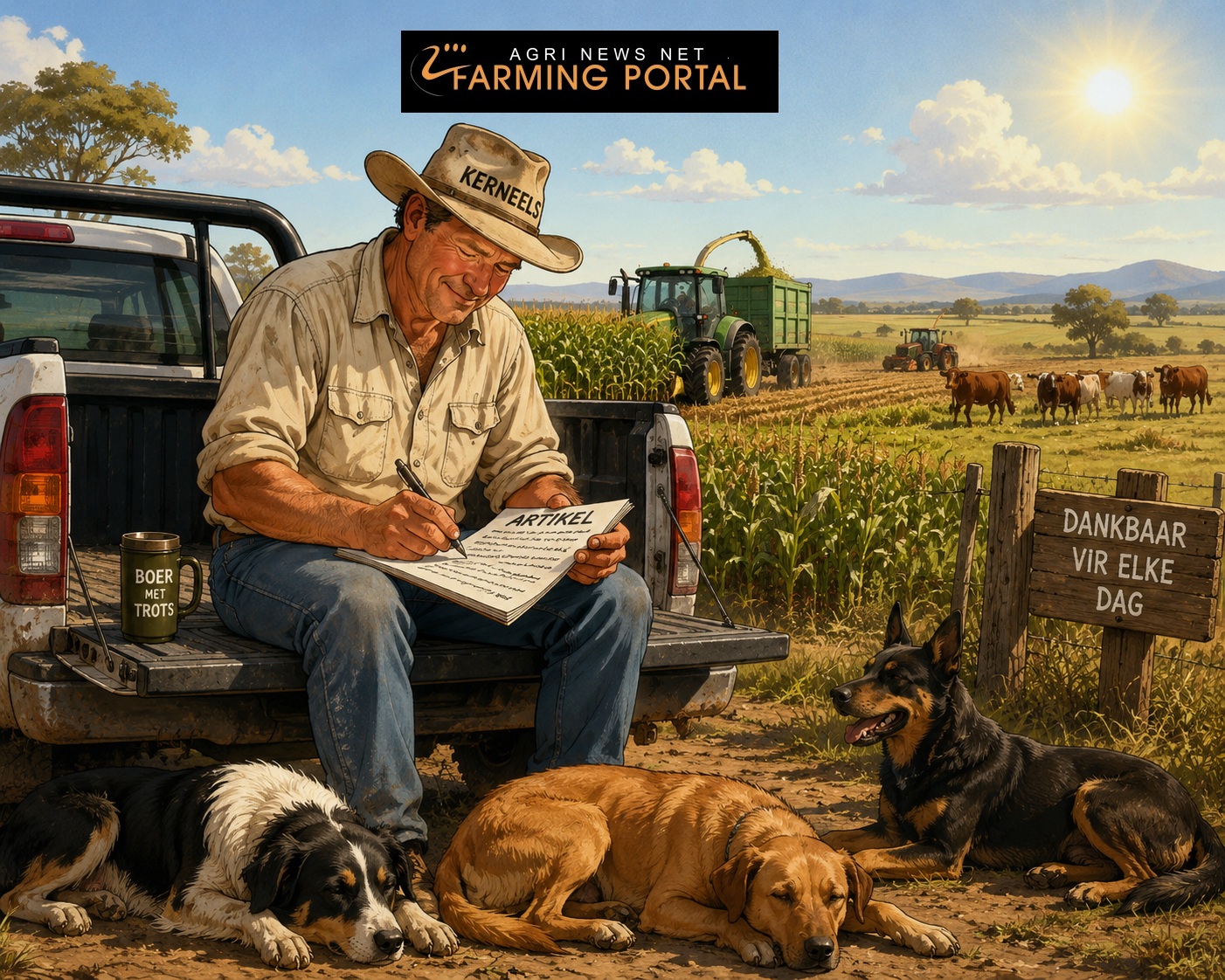
OOM KERNEELS
Vandag gesels ek in Afrikaans.
Ons is in die middel van die jaar, in die middel van die winter, en in die middel van ’n krisis wat al vir jare aanhou. Mense wat oor ons grense kom en maak net wat hulle wil in Suid-Afrika. En intussen dink die regering nog steeds hulle het beheer. Suid-Afrika steek af op ’n politiek gelaaide tydperk. Op 30 Junie beplan groepe soos March and March betogings. Hulle eis sterker optrede teen onwettige immigrasie en dat ongedokumenteerde buitelanders die land moet verlaat. Die regering se antwoord is ferm: daar is geen nasionale stilstand nie. Dit is ’n gewone werksdag. Besighede moet oop wees en werknemers moet werk, anders geld die “geen werk, geen betaal”-reël. Veiligheidsmagte is op hoë gereedheid en het gewaarsku dat intimidasie, padblokkades of onwettige inmenging nie geduld sal word nie. Die Grondwet is duidelik. Immigrasiewette moet toegepas word, maar net deur gemagtigde beamptes. Privaat burgers kan nie identite nagaan nie, padblokkades oprig of besluit wie behoort en wie nie. Vreed same protes word beskerm. Geweld, intimidasie en kollektiewe straf nie. Ons het dit sedert 2008 gesien: hoe vinnig dinge kan ontspoor. Wanneer dit gebeur, is dit gemeenskappe, besighede en werksgeleenthede wat die grootste skade ly, met ernstige ekonomiese en reputasie-risiko’s vir Suid-Afrika en die hele streek.
Maak seker jy weet wie jy in diens het. Die regering het sy inspekteurs aangestel om werkloosheid te bekamp, en hulle gaan seker maak jy voldoen. Ons boere is steeds die ruggraat van ons land se werksmag. Daar is min dinge wat so lekker voel soos pm mielies te stropers en die tenk is vol voor jy die draai maak. Maar die pryse bly steeds ’n kopseer, al is ons dankbaar vir die oes op die land. "n Koppie lekker warm koffie so langs die punt van die land so vroeg in die more is iets om te waardeer as jy 'n ware boer is- Die vars koue lug so in jou longe.
En vir die manne met die dik brille en die ekonome wat altyd alles voorspel… miskien moet hulle bietjie gaan kyk wat hulle voorspel het oor die ru olieprys. Geluk aan Ba Fana - met hulle westryd- ek weet nie veel van sokker nie- maar ek kan sien dat die edele Minister van Sport hom gate uitgeniet daar in die VSA- so op ons hard verdine Belastingeld.
Geniet die week. Pas jouself op, pas jou mense op, en pas jou plaas op. Oom Kerneels.
Cyril Ramaphosa says there are no farm murders in South Africa. He also says that "Kill the Boer" is not a literal chant to kill. pic.twitter.com/iYzXWYRT5G
— Alice VL (@RiseAgainstEvil) June 27, 2026
FMD Update by RMIS (Red Meat Industry Services) CEO Dewald Olivier. Unpacking the new Section 9 and what it means for the industry. pic.twitter.com/z1SuNaUtPx
— John Steenhuisen MP (@jsteenhuisen) June 28, 2026