







-Welcome to our world- the real world of Farming and Agriculture in South Africa- Local and International news- (Farmingportal.-168,260 hits per minute)
 This AGRI NEWS RUSH - Just that one Step Ahead -Some of the news stories of this week-, SUNDAY EDITION - ALWAYS ON TIME - AGRI NEWS RUSH is now one of the most read Articles on a Sunday
AGRI NEWS RUSH - HEADLINE NEWS OF THE WEEK - www.agrinewsnet.co.za
Johann Kotzé, uitvoerende hoof van Agri SA, het by Agri Wes-Kaap se kongres in Goudini gesê kritiek is belangrik, maar verhoudings bou is wat uiteindelik werk. Hy het verduidelik dat hy die staat hanteer soos hy met sy ma gepraat het: met respek en liefde, al stem hy nie altyd saam nie. As ’n mens elke dag net negatief uitwys, bou dit nie aan verbetering nie.
The South African Veterinary Council says biosecurity isn’t just for disease outbreaks, it starts with everyday habits on the farm. Simple actions like disinfecting machinery, inspecting new animals, and doing health checks can stop diseases before they spread.
Fruit farmers are calling on Premier Foods to pause its plan to close the Tulbagh canning factory and instead engage with them to find a workable solution, rather than pursue what they call a “scorched-earth” exit.The Tulbagh plant, once a core business of Rhodes Food Group, is a flagship facility in the Boland stonefruit area and takes fruit from about 2,000 hectares planted specifically for it.
Transport Minister Barbara Creecy says the Port of Cape Town has made significant operational improvements ahead of the 2026/27 deciduous fruit export season. The port handles around 80% of South Africa’s deciduous fruit exports, including citrus, table grapes, apples, pears and stone fruit.
The Land Bank is facing scrutiny over two separate issues. On the first, black wine producers have turned to Parliament after waiting more than a year for transformation funding.
Die Stad Kaapstad sê sy mariene-eenheid het die afgelope jaar groot suksesse behaal, insluitend 'n byna 500-persent toename in die herwinning van gestroopte mariene hulpbronne. Herwonne goedere het gestyg van ongeveer 2 500 tot bykans 15 000 items. Wetstoepassers het ook 953 onwettige sjebiens gesluit.
The new Transformation Fund is being described as the start of the end of BEE as it currently operates in South Africa. The proposal, announced in February, would let companies earn BEE scorecard points by contributing directly to the fund instead of meeting complex enterprise and supplier development requirements themselves.
Minister van Landbou Willie Aucamp het op die RPO-jaarkongres erken dat talle foute die afgelope jaar met die bekamping van die bek-en-klouseer (BKS)-krisis begaan is en dat meer foute waarskynlik nog gemaak sal word. Hy is egter vasbeslote dat strukturele en wetgewende kwessies nie verdere vervreemding tussen die regering en die bedryf moet veroorsaak nie.
South Africa’s 2026 agricultural outlook is broadly positive for field crops and horticulture, but wheat is under pressure.Lower global wheat prices, higher input costs linked to the Middle East conflict, and poor weather in some regions have led to reduced plantings.
In the meat market, prime cattle prices remain under pressure, while weaner calf and feeder lamb prices are holding surprisingly strong. Producers are being urged to start planning for a possible El Niño.
South Africa remains the main market for live Boer goat exports from Namibia, with around 98% of them going to the traditional market there.The industry emphasizes how important animal health is, with disease surveillance, testing and vaccination helping to protect the livestock sector and keep key export markets open.
Minister of Agriculture Willie Aucamp, who has been in the post for little more than a month, has identified foot-and-mouth disease, long administrative delays, outdated systems, rural safety and market access as major challenges facing South African agriculture.
South Africa’s blueberry industry appears to be entering a new phase focused on efficiency rather than expansion. According to the latest USDA market analysis for 2026, planted area has declined from a peak of 3,800 hectares in 2022/23 to an estimated 2,650 hectares in 2025/26, yet production continues to rise and is projected to reach 38,900 tonnes.
An incident register recorded 93 farm attacks and 24 farm murders from January to July 2026, compared with 94 attacks and 15 murders in the same period of 2025. Attacks remained virtually unchanged, but murders in the register rose by 60% - nine more deaths.The author argues this sharp increase in fatalities deserves attention regardless of political debates over terminology.
Public trust in the police in South Africa has fallen to a serious low, while the World Bank estimates that crime costs the economy about R700 billion per year, roughly 10% of GDP. According to the Centre for Risk Analysis, those losses are driven mainly by direct losses, private security spending and lost economic opportunities.
Renowned economist Dawie Roodt told delegates at the 2026 Biznews Conference in the Drakensberg that South Africans should legally do everything possible to pay as little tax as possible.He argued that SARS has shifted from serving taxpayers to serving the state and politicians, and that a small number of individuals and businesses are already overtaxed to an unsustainable degree
Prof. Ferdi Meyer, managing director of the Bureau for Food and Agricultural Policy, says South African farmers are more resilient today than 10 years ago, even with concerns about a forecast super-El Niño ahead of the coming summer season.
Weather is always top of mind for farmers. The information is available, but the challenge is how to interpret it and use data to protect or improve yield. That is the gap being addressed with a weather service aimed at helping producers make better decisions.
Dele van Europe beleef die vyfde hittegolf van die jaar met meer as 135 miljoen mense wat na verwagting temperature van bo 35 grade Celsius sal ervaar. Roemenië het begin om sy enigste kragsentrale tydelik af te skakel nadat watervlakke op die Donauriver tot 'n rekord laagtepunt gedaal het.
If you are using our content in your media coverage or on any agricultural radio programme, we would greatly appreciate it if you could credit the source. We understand how valuable and convenient this information can be—especially on a Monday morning after a weekend of NO WORK .
As of mid-August 2026 (latest available weekly data, mainly 7–14 August)These are primarily farm-gate / abattoir purchase prices (R/kg, excluding VAT) reported by sources such as Absa, RPO and AMT. Prices vary by region, quality, volume and exact date.Cattle
- Weaner calves (approx. 200–250 kg): R48.30 – R48.70/kg
- A2/A3 (Super grade carcass): R66.30 – R69.20/kg
- B2/B3: R60 – R65/kg
- C2/C3: R58 – R61.50/kg
- Feeder / store lambs: R55 – R58/kg
- A2/A3 carcass: R105 – R111/kg
- B2/B3: R82 – R83/kg
- C2/C3: R78 – R82/kg
- Porkers: R27.65 – R30.50/kg
- Baconers: R28.10 – R29.30/kg
- Frozen whole bird: R32 – R34/kg
- Fresh whole bird: R35 – R38/kg
- IQF portions: R32 – R35/kg
- These are national average producer-level prices and can differ significantly by province and specific sale.
- Retail prices are substantially higher (e.g. beef often R150+/kg, chicken around R65–70/kg average in July retail data).
- Yellow maize (key feed cost) was trading around R3 770/ton in mid-August.
- Markets remain sensitive to feed costs, disease (FMD, ASF, HPAI) and the developing El Niño outlook.

- Aug 26: 3,509 (+27)
- Sep 26: 3,539 (+23)
- Dec 26: 3,682 (+28)
- Mar 27: 3,754 (+21)
- Aug 26: 3,543.20 (+29.20)
- Sep 26: 3,579.80 (+26.80)
- Dec 26: 3,718 (+28)
- Mar 27: 3,778 (+28)
- Aug 26: 5,935.40 (+1.40)
- Sep 26: 5,964 (−6)
- Dec 26: 6,002.20 (−7.80)
- Mar 27: 6,135 (unchanged)
- Aug 26: 10,270 (−70)
- Sep 26: 10,350 (−50)
- Dec 26: 10,512.40 (−43.60)
- Mar 27: 10,139 (+4)
- Sep 26: 6,977.80 (+57.80)
- Nov 26: 7,084.80 (+28.80)
- Mar 27: 7,256 (unchanged)
- White maize: R 3,509 (+0.89%)
- Yellow maize: R 3,543.20 (+0.95%)
- Soybeans: R 7,836 (+0.36%)
- Sunflower seed: R 10,282 (−0.94%)
- Wheat: R 5,934 (−0.19%)
50 Key South African Headline News Stories in Agriculture, Farming & Agritech 14th Augustus 2026
Here is a curated list of 50 South African farming and agriculture headlines reflecting key developments and reporting as of around 13–14 August 2026. Headlines focus on employment, weather/El Niño risks, crops (especially the record maize/corn harvest), livestock/biosecurity (FMD), horticulture, trade, machinery, and policy.
- SA farming defies job market slump with 39,000 annual growth – for now
- KZN sugarcane farmers welcome recent rains following lengthy dry spell
- South Africa harvesting largest corn crop on record, estimated at ~18 million metric tons
- Tractor sales fall 31% year-on-year in July 2026 amid higher input costs and El Niño concerns
- South Africa may struggle from the expected El Niño, but the Southern Africa region faces more risks
- SA may have planted the smallest wheat area in nearly 100 years
- Foot-and-mouth disease high on the KragDag agenda
- Minister Willie Aucamp delivers opening keynote at BFAP 2026 Baseline Report launch
- Graan SA and producers protest at JSE over soybean location differential decision
- Blueberry season in SA: bumper north, uncertain Western Cape
- Climate uncertainty reshapes table grape industry thinking
- ‘Highly unusual’ South African citrus season tests industry resilience
- Sugar cane farmers take fight to Treasury as imports surge
- GMOs and precision farming help bring South African food prices down
- Agribusiness confidence falls to 45 in Q2 2026 – lowest since Q2 2024
- SA approaching the end of its 2025-26 maize harvest with strong deliveries
- Agriculture employs about 944,000 people in Q2 and adds jobs year-on-year
- El Niño conditions strengthening; impact on 2026/27 summer crop season under close watch
- Standard Bank invests R3.45 billion in climate-smart agriculture
- FMD vaccine supplies ramp up as private-sector role expands under new framework
- Export expansion is crucial for the long-term growth of SA agriculture
- SA agricultural exports totalled US$3.7 billion in Q1 2026, up 11% year-on-year
- Record summer grain and oilseed harvest (over 21 million tonnes) supports food security and exports
- Middle East conflict raises risks for fertiliser, fuel, and shipping costs
- Digital platform aims to simplify FMD vaccination processes for farmers
- New act strengthens South Africa’s defences against plant diseases
- Dry winter takes its toll on Western Cape crops and veld
- Premier Group’s closure of Tulbagh fruit processing facility threatens jobs and supply chains
- Employment Tax Incentive offers valuable payroll relief for agricultural employers
- Dr Marinda Visser champions biosecurity research and mentors agriculture’s next leaders
- Aucamp expands FMD advisory structures to include more industry representatives
- SA agriculture well placed to weather El Niño drought thanks to high stocks and soil moisture
- AgriSA warns South Africa is falling behind on key agricultural trade negotiations
- Lithium prospecting raises concerns for farming communities on the KwaZulu-Natal South Coast
- Seed industry innovations credited for powering SA agricultural yields and quality
- Potatoes remain South Africa’s most consumed vegetable with reliable year-round supply
- Regenerative agriculture shifts from sustainability discussion to commercial necessity
- Port of Cape Town shows operational improvements despite poor global rankings
- Land Bank faces challenges over debt recovery and farm liquidations
- Game takes centre stage at the Thabazimbi Show
- Loriza Brahmans remains a cornerstone Brahman stud of South Africa
- New and alternative grape varieties: dare to drink different
- Early-developing El Niño raises risk of hotter, drier 2026/27 summer
- South Africa overtook Spain as the world’s largest citrus exporter by volume in 2025
- Agriculture Minister Willie Aucamp emphasises reducing red tape for world-class farmers
- High input costs and softer commodity prices pressure margins despite bumper harvests
- Positive Indian Ocean Dipole and El Niño developments closely monitored for rainfall impacts
- Short-term forecasts point to possible September rains over the summer rainfall region
- Naturally occurring fungus shows promise as biological control against African armyworm
- BFAP 2026 Baseline highlights export growth and inclusivity as key themes for SA agriculture
These reflect the dominant themes in mid-August 2026 coverage: a strong 2025/26 harvest season providing buffer stocks, rising concerns about the developing El Niño for the next summer crop, ongoing FMD management, horticultural export challenges, employment resilience in farming, and policy/trade focus under the current agricultural leadership. Headlines can shift quickly with new weather data, crop estimates, or market developments.

READ MORE ( Stats) Listen to all our Daily Audiocast - It is doing very good. But also see that some news mediums like to follow us.
MORE GOOD NEWS - AUDIO AGRI NEWS NET which was selected by Million Podcasts as one of the Top 100 Agriculture Podcasts, Top 100 Farming Podcasts and Top 100 Sustainable
Agriculture Podcasts on the web. READ MORE
- National average: 95.8% full (essentially unchanged from the previous week; similar to the same period last year).
- Total tracked capacity: ~29,334 Mm³ across ~219 major dams.
- Most summer-rainfall interior provinces are near or above full supply. Western Cape (winter-rainfall) is lower but still improving.
Provincial averages (approx., capacity-weighted):
- North West: 102.4%
- Free State: 100.2%
- Limpopo: 98.8%
- Mpumalanga: 98.2%
- Gauteng: 98.5%
- Eastern Cape: 89.4%
- KwaZulu-Natal: 87%
- Northern Cape: 84.7%
- Western Cape: 80.4%
|
Dam
|
Province
|
Capacity (Mm³)
|
Level
|
Change vs previous week
|
|---|---|---|---|---|
|
Gariep
|
Free State
|
4,903
|
99.3%
|
Stable
|
|
Vanderkloof
|
Free State
|
3,137
|
100%
|
Slight decline
|
|
Sterkfontein
|
Free State
|
2,617
|
98.8%
|
Stable
|
|
Vaal
|
Free State
|
2,561
|
101%
|
-0.3%
|
|
Pongolapoort
|
KZN
|
2,395
|
83.5%
|
-0.3%
|
|
Bloemhof
|
Free State
|
1,243
|
106.4%
|
Stable
|
|
Theewaterskloof
|
Western Cape
|
479
|
78.1%
|
+0.2%
|
- Overall system: 97.9% (slight decline from 98.8% the prior week).
- Vaal Dam: 101.0%.
- Bloemhof Dam: ~106.3%.
- Sterkfontein: 98.8%.
- Grootdraai: 96.9%.
Remained above 100% throughout the week, averaging 101.41% (range 100.63%–101.89%). Inflows fluctuated (average ~60 m³/s); discharges managed without major spilling. Figures for 15–16 August were still being finalised in mid-week reports.

- Open/unresolved outbreaks: 2,403 (up sharply from 836 in February 2026).
- Total reported (including closed): ~2,444.
- Highest numbers: Free State (636 open), North West (407), Eastern Cape (365), KwaZulu-Natal (326), Gauteng (280), Mpumalanga (254). Lower numbers in Limpopo, Northern Cape, and Western Cape.
- Over 5.4 million cattle vaccinated by mid-2026 as part of a national campaign targeting high coverage (aiming for ~80% of the national herd). The national dairy herd has largely received a first dose, with second doses prioritised.
- Millions of doses imported (Turkey/Dollvet, Argentina/Biogénesis Bagó, and others). By early/mid-August, ~17 million doses had been brought into the country, with further consignments arriving or en route (including private-sector channels). Distribution to private veterinarians has expanded.
- Policy shift (July 2026): Private sector now permitted to import, distribute, and administer FMD vaccines, ending previous exclusive government control. New Section 9 control measures (signed July 2026) provide a more flexible, risk-based national framework for quarantine, movement, controlled slaughter, and recovery pathways.
- Local production: Agricultural Research Council (ARC) interim facility at Onderstepoort produces ~20,000 trivalent (SAT1/2/3) doses per month. Plans to scale to ~200,000 doses/month, but a ~R1.2 billion funding gap is delaying full upgrades (targeted completion around early 2027).

- General conditions: Partly cloudy and cold to cool across much of the country.
- Precipitation: Mostly dry. Isolated showers possible over the north coast of KwaZulu-Natal.
- Winds: Damaging winds possible over the southern parts of the Northern Cape.
- Temperatures: Cooler than recent days in many areas, with cold mornings possible (including frost risk in places on the Highveld and Free State).
- Gauteng, Free State, North West: Fine to partly cloudy and cool. Morning frost possible in places (especially Free State and southern Gauteng).
- Mpumalanga & Limpopo: Fine to partly cloudy and cool to cold on the Highveld; partly cloudy in the Lowveld/northern areas.
- KwaZulu-Natal: Fine and cool over much of the interior; partly cloudy in the north-east, with isolated showers possible along the north coast. Morning fog patches possible in places.
- Eastern Cape: Cool and partly cloudy conditions expected to dominate.
- Western Cape (including Cape Town): Cool to mild, with partly cloudy to cloudy skies. Highs typically in the mid-teens °C (around 15–17°C in Cape Town area forecasts); light winds.
- Northern Cape: Fine, windy and cool to warm in places; possible damaging winds in the south. Morning fog along the coast possible earlier in the weekend period.
- Cape Town: Highs around 15–17°C, partly cloudy/cloudy, cool, low chance of rain.
- Johannesburg/Pretoria area: Cool and fine to partly cloudy (highs typically low-to-mid 20s°C or cooler depending on exact location), with cold mornings.
- Durban/coastal KZN: Milder but still cool, partly cloudy, isolated shower risk further north.
- Interior Highveld/Free State towns: Sunny to partly cloudy, cold nights/mornings, mild afternoons.

DISCLAIMER
The views and opinions expressed in this program are those of the writers and do not necessarily reflect the views or positions of any entities they represent. The information contained in this website is for general information purposes only. The information is provided by CRA and while we endeavour to keep the information up to date and correct, we make no representations or warranties of any kind, express or implied, about the completeness, accuracy, reliability, suitability or availability with respect to the website or the information, products, services, or related graphics contained on the website for any purpose. Any reliance you place on such information is therefore strictly at your own risk.Just for your information. - We need to share this as this is part of Farming and Agriculture.
AGRI NEWS NET stands as South Africa’s leading source for farming and agriculture news, delivering trusted, up-to-date content 7 days a week, 365 days a year. With over 50 “good news stories you can trust,” the platform is driven by 30 years of practical farming and media experience, ensuring a deep understanding of the needs and realities of farmers and the agricultural sector. AGRI NEWS NET prides itself on being committed, independent, focused, and always on time. As part of the CRA Group, the platform leverages its extensive expertise to provide reliable, farmer-centric news. Its content is compiled using advanced AI technology, ensuring accuracy and relevance while staying connected to the broader global farming and agriculture community. For the third consecutive year, AGRI NEWS NET’s Daily Audiocast has been ranked among the top 15 agricultural podcasts on Feedspot, a testament to its quality and impact. The audiocast delivers concise, engaging updates, making it a go-to resource for farmers, industry professionals, and agriculture enthusiasts seeking timely insights. With a focus on “good news stories,” AGRI NEWS NET highlights positive developments, innovations, and successes in South African agriculture. Rooted in real-world farming knowledge and media expertise, AGRI NEWS NET bridges the gap between farmers, policymakers, and the public. Its AI-driven platform ensures comprehensive coverage, from local issues . By focusing on practical, trustworthy content, AGRI NEWS NET empowers the agricultural community to stay informed and inspired.

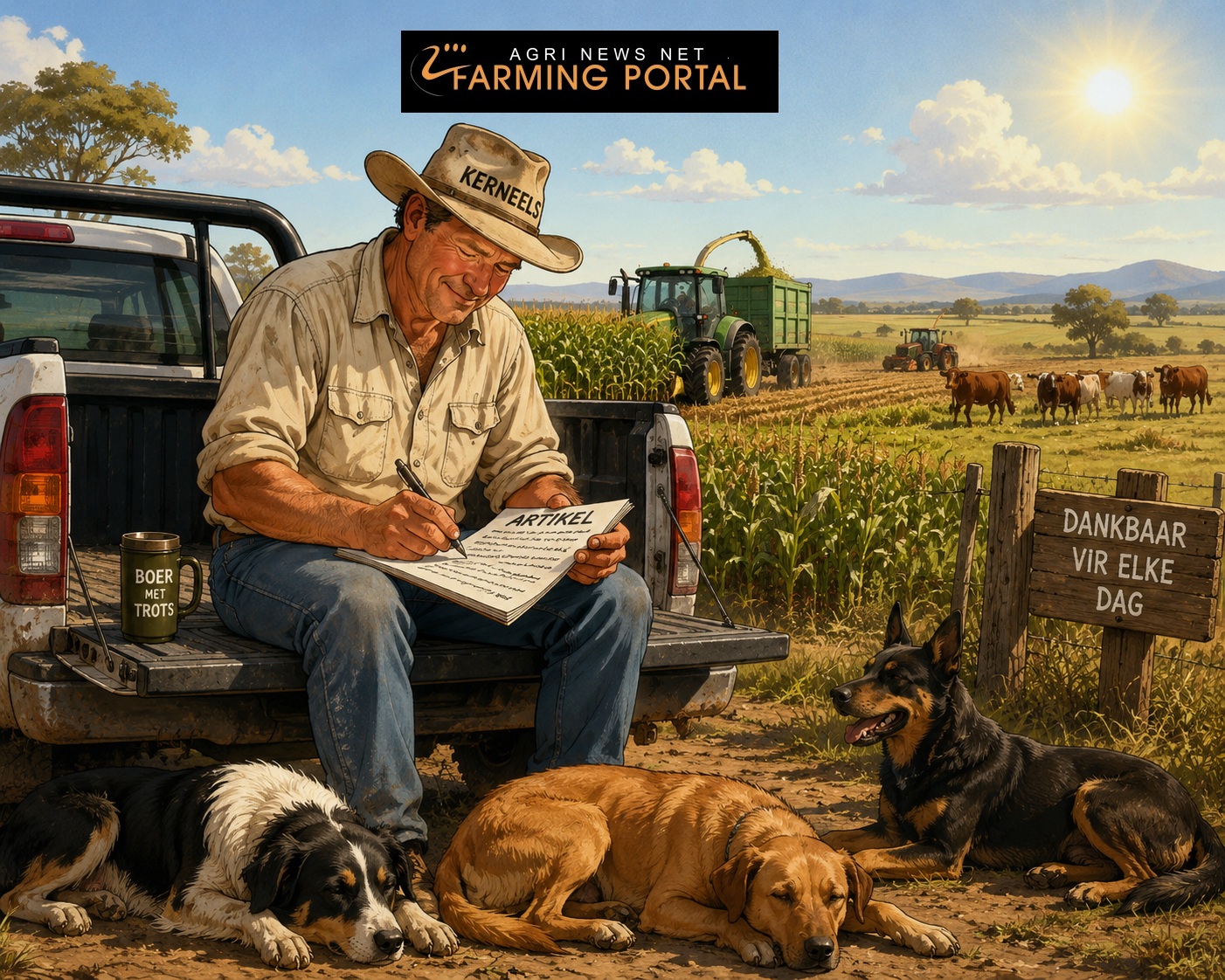
OOM KERNEELS
Van die Plaas af:
Dit was "leeu" koud hier in die Vrystaat die afgelope week. Ek het my trots in my sak gesteek en die warmwatersak agter my rug gesit. Gelukkig het die welkome reën alles weer mooi afgewas.Om deesdae televisie te kyk met al daardie irriterende advertensies van versekering, "hamburgers" en hoestroop is 'n "challenge". Baie saaks om te sien hoe aanbieders huil as iemand weggaan.
Hoeveel keer wil hulle nog daai gemors in ons kele afdruk? Die nuus is ook maar net negatief en oud en die aanbieders sukkel met die uitspraak van woorde. Ek sien die manne wat vrou soek het al klaar 'n paar dames verloor. Dis dalk waarom 'n paar van hulle op TV vroue loop soek.
Die All Blacks het reeds 3 van hulle wedstryde gewen teen Suid Afrika se groot unies- nou wag die Springbokke volgende naweek. Wat my verbaas is hoekom die volkslied gespeel word by die provinsionale spanne- dis dalk tyd dat elke provinsie sy eie lied kry- waar is hope Suid Afrikaanse sangers met hulle braai, jag en skiet, soen en brandewyn liedjies- en rugby rympies wat almal op dieselfde "Doef- Doef' klanke gesing en herhaal word.
Ons oes is af en ons kyk al vir 'n nuwe jaar. Ons is almal baie dankbaar Ek sien die slim ekonome voorspel alweer moeilikheid, maar van dankbaarheid vir die oes wat ons het, is daar nie veel sprake nie. Dit lyk of bek-en-klouseer nou onder beheer is en die boere is besig om hulle kuddes baie vinnig te spuit. Dit was nogal baie snaaks om te sien hoe ons graanboere die week betoog het, maar ons sal sien of dit werk.
Die jagseisoen kom ook amper tot 'n einde en die manne het duur betaal vir die bokke wat hulle geskiet het met hulle duur gewere en "gadgets".Die regering en sy "meelopers" verbaas my nie meer nie. Want hulle alles sê en aanpak is maar net 'n bewys van hul kleinlikhede. Daar is 'n spreekwoord wat sê: "Jakkals prys sy eie stert /sterkte" Onderhoud en bou is laaste op hulle lys. Verstommend as mens sien hoe is daar gesteel en word daar nog gesteel. Die ou dorpie waar ons bly word bestuur deur 'n man wat geen opleiding het nie, en hulle boeke klop nooit.Ten spyte van alles bly dit 'n mooi land, en ons moet net glo en vertrou dat geregtigheid sal seëvier.
Getruide, my liewe vroutjie, verjaar die maand en ek moet vir 'n geskenk gaan soek.Sal maar sien hoe en waar.Deesdae moet 'n mens baie geld hê om dokter toe te gaan, en die mediese fondse is ook nie genadig nie.Bly warm en gesond en vertrou. Geniet die week. Dit lyk of dit warmer gaan word.
Ons moet wakker word. Die manne met die groot dik brille kom vertel vir ons net wat ons wil hoor .Boer voort, hou kop, en onthou: die mense wat die minste skree, is gewoonlik die wat die meeste werk. Tot volgende week.
Mag julle almal ’n lekker week he ons gesels weer. OOM Kerneels.

NS -We normally do not post sponsored or external videos on our professional platforms. However, videos of this nature — which are non-marketing and informative — are not freely available YouTube channels. We will soon have our own Professional Video Channel form our own Production house.