







-Welcome to our world- the real world of Farming and Agriculture in South Africa- Local and International news- (Farmingportal.-168,260 hits per minute)
 This AGRI NEWS RUSH - Just that one Step Ahead -Some of the news stories of this week-, SUNDAY EDITION - ALWAYS ON TIME - AGRI NEWS RUSH is now one of the most read Articles on a Sunday
AGRI NEWS RUSH - HEADLINE NEWS OF THE WEEK - www.agrinewsnet.co.za
Deep in South Africa’s Knysna forest, a female elephant named Strangefoot, estimated to be around 50 years old, is believed to be the last survivor of the forest’s once larger elephant population. Decades of habitat fragmentation isolated her, and a plan to introduce other elephants to join her did not proceed, leaving her future unchanged.
Departement van Landbou het twee nuwe gevalle van bek-en klouseer in die Heilbron en Bloemfontein gebiede bevestig. Dit bring die totale aantal bevestigde gevalle in die Vrystaat op 772 te staan, waarvan bykans 600 suksesvol opgelos en kwarantynmaatreëls op plase opgehef is. Bek-en klouseer is in 19 Vrystaatse munisipaliteite aangemeld insluitend Kroonstad, Welkom, Sasolburg en Frankfort.
South African citrus producers must brace for significantly lower net income in 2026 than in 2025 due to weak market conditions, a stronger rand, more expensive shipping, logistical disruption and quality problems.g.
South Africa's sugar millers are on strike while the industry is already under pressure from cheap imports and weak tariff protection.Sasma says the wage dispute stems from broader economic pressure. Local producers are struggling due to subsidized imports from Brazil and India. Imports rose from 55,213 tons to 94,984 tons in Jan-May 2026 (+72%).
More than 1.3 million animals have been vaccinated against foot-and-mouth disease in North West since a mass campaign began in March.The province received 1,570,100 doses and vaccinated 1,315,401 animals so far, over 80% of its 1.4 million target herd, with teams still working to reach remaining owners.
Raspberry markets are showing contrasting conditions shaped by weather and supply.In France, tight supply after heatwaves kept prices firm, standard protected-crop raspberries from the Southwest averaged €17.20/kg on 12 Aug, up €0.80/kg, with slight recovery by 19-20 Aug as heat subsided but prices still firm.
FNB Economics has warned that South Africa's reliance on imported fuel and road freight leaves transport and production costs vulnerable to global oil-price shocks.Fuel prices fell 7.8% month on month in July but were still 20.6% higher year on year, according to Stats SA's latest CPI.
This week’s agricultural markets and economic environment present a mix of weather, price and policy developments that producers will need to watch closely. El Niño is developing rapidly and may peak by November or December, while little rain is expected over the next week or two.
Vir elke rand wat boere via kultivar- en tegnologie-heffings aan navorsing en ontwikkeling bestee, kry hulle gemiddeld R2,20 terug, sê Sacta wat vanjaar 10 jaar oud is.Uitvoerende hoof Andrew Bennett sê van elke R100 wat ontvang word, gaan R2,50 vir kommissie, sowat R3 vir administrasie, R19,50 vir transformasie en R75 aan saadmaatskappye vir teling en tegnologie.
President Cyril Ramaphosa launched Phase Three of the Government-Business Partnership in Johannesburg on 20 August, shifting from stabilisation and reform to investment, growth and job creation.
South Africa’s national dam levels currently stand at a strong 95.5%, offering an important buffer as the country prepares for an intense El Niño period expected to bring higher-than-normal heat and drier conditions.
Vrystaat Landbou spreek ernstige kommer uit oor swak bestuur van provinsiale padinstandhoudingsbronne. Terwyl boere self paaie moet gelykmaak om produkte te vervoer en toegang tot skole en noodsaaklike dienste te verseker, staan staatstoerusting vir maande ongebruik langs die pad, sê president Francois Wilken.
The global cotton trade is expected to maintain a positive medium-term outlook despite growing supply pressures on prices. World cotton trade is estimated at 9.4 million tonnes in 2025/26, up 2% from the previous season, and is projected to rise to 9.6 million tonnes before reaching approximately 10.3 million tonnes by 2028/29.
The National Treasury's draft Public Procurement Regulations would require businesses getting state contracts below R20 million to be 100% black-owned, warns NEASA CEO Gerhard Papenfus.
The South African wine industry is under pressure, with producer sentiment leaning towards pessimism as sales are slow and cash flow is strained.
Priya Seetal, sugar and health policy manager at the South African Sugar Association, says sugar policy must be viewed through its agricultural and rural economic impact, not just nutrition.South Africa's sugar industry is labour-intensive, contributes about 6% of agricultural output, and anchors rural towns.
Petrol and diesel are driving inflation in South Africa, with prices R4.23 and R5.40 per litre higher than a year ago despite a July cut.Stats SA reported headline CPI at 4.3% y/y in July, down from 5.0% in June, largely due to a R1.96/l petrol and R3.59/l diesel cut that shaved 0.4 percentage points off inflation.
South Africa's dragon fruit industry has had a challenging season, with many farmers exiting, consolidating from 20 to 14 commercial members of the Dragon Fruit Growers' Association of Southern Africa and from an estimated 120ha in 2024 to 100ha now.
When grain makes the news, two things usually follow — supermarkets profiteering by warning bread will go up even though the flour was bought a year ago, and grain markets being swamped by speculative traders.The author warns the market can no longer ignore what is happening, and the issue is not just whether Russia and Ukraine have grown enough wheat, but whether they can export it.
If you are using our content in your media coverage or on any agricultural radio programme, we would greatly appreciate it if you could credit the source. We understand how valuable and convenient this information can be—especially on a Monday morning after a weekend of NO WORK .
- Weaner calves (200–250 kg): Approximately R47–R49/kg (recent figures around R47.36–R48.36/kg; some reports noted a nearly 3% weekly decline in mid-August).
- Class A2/A3 (Super/A-grade carcass): Around R66–R69/kg (recent readings R66.67–R69.21/kg).
- Class B2/B3: Approximately R59–R65/kg.
- Class C2/C3: Approximately R57–R62/kg.
- Feeder / store lambs: Approximately R55–R57/kg.
- Class A2/A3 lamb carcass: Around R106–R111/kg (recent R106.13–R110.82/kg).
- Class B2/B3: Approximately R82–R91/kg.
- Class C2/C3: Approximately R79–R82/kg.
- Porkers: Approximately R27–R31/kg (recent readings around R27.65–R30.93/kg).
- Baconers: Approximately R28–R29/kg (recent around R28.14–R29.03/kg).
- Frozen whole bird (ex-abattoir): Approximately R31–R33/kg.
- Fresh whole bird: Approximately R34–R39/kg.
- IQF portions: Approximately R31–R35/kg.
Weaner calf prices showed some weekly softening after strong earlier levels, while slaughter beef remained firm. Sheep prices continued to benefit from tight supply. Pork stabilised after earlier strength, and chicken faced mild pressure from better availability. Rising maize prices were noted as a potential future cost pressure for feedlots and intensive livestock. FMD continues to influence red-meat dynamics, particularly cattle movement and export potential.

- White maize (WMAZ) spot / nearby: Approximately R3 688 – R3 760 per ton
(recent readings around R3 688–R3 760/t; some sessions showed mild daily declines of 0.5%). - Yellow maize (YMAZ) spot / nearby: Approximately R3 700 – R3 750 per ton
(recent readings around R3 700–R3 750/t).
- Soybean (SOYB) spot / nearby: Approximately R8 060 – R8 200 per ton
(recent readings around R8 060–R8 200/t, with some upward movement).
- Sunflower (SUNS) spot / nearby: Approximately R10 400 – R10 555 per ton
(recent readings around R10 400–R10 555/t).
- Wheat (WEAT) spot / nearby: Approximately R6 080 – R6 160 per ton
(recent readings around R6 080–R6 156/t).
South Africa continues to benefit from a large maize surplus following the record 2025/26 harvest, which is keeping maize prices at moderate levels. Oilseeds (soybeans and sunflower) are trading firmer relative to maize. The market is monitoring the developing El Niño outlook for the 2026/27 summer season, potential changes in export demand, and currency movements. Prices can vary by delivery point and contract month; producers and buyers should check the latest SAFEX closing prices or Grain SA daily reports for precise figures.

50 Key South African Headline News Stories in Agriculture, Farming & Agritech 23rd August 2026
- BFAP Baseline 2026 launched – agriculture must focus on export-led growth, technology and animal health to reach 2050 potential.
- Agriculture Minister Willie Aucamp says FMD is now under control thanks to large vaccine supplies.
- More than 17 million FMD vaccine doses already imported; further consignments expected.
- Western Cape reports 82% of provincial herd vaccinated against FMD.
- South Africa and India finalise long-awaited citrus export deal after nearly a decade of negotiations.
- Additional cold-treatment options approved for South African citrus entering India.
- South Africa remains the world’s largest citrus exporter by volume (2.9 million tonnes in 2025).
- Record maize harvest of approximately 17–18 million tonnes being completed.
- South Africa’s grain stocks position the country as a regional food-security buffer against expected El Niño.
- Super El Niño risk for 2026/27 summer season continues to worry farmers and analysts.
- High soil moisture and full dams from the previous wet season provide a buffer against drought.
- Tractor sales fell 31% year-on-year in July amid higher input costs and weather uncertainty.
- Agribusiness confidence remains below the neutral 50-point mark.
- Meat imports rose sharply during the FMD crisis.
- Private-sector participation in FMD vaccination expanded through new regulations.
- Farmers can now register as authorised persons to vaccinate their own livestock.
- Conservation Agriculture Week highlights soil health and sustainable grain systems.
- Swartland wheat farmers report severe “green drought” stress and call for rain.
- Prayer days for rain organised across Western Cape grain areas.
- Canola and wheat yields under pressure from heat and dry conditions in the winter rainfall region.
- Silage cutting started unusually early in parts of the Swartland due to poor growth.
- Global cotton trade outlook remains positive despite tighter supply.
- Brazil maintains position as top cotton exporter.
- South African cotton plantings up 16% with production forecast to rise 26%.
- Smallholder cotton production still faces ginning and logistics challenges.
- President Ramaphosa highlights agriculture and agro-processing in Government-Business Partnership Phase 3.
- Focus on water, transport, biosecurity, finance and market access for the sector.
- Agricultural exports performed strongly in early 2026 (record quarterly figures reported).
- Horticulture remains a key growth driver through exports.
- Livestock sector still dealing with higher beef and pork prices linked to disease.
- African swine fever continues to disrupt the pork industry alongside FMD.
- Absa and BFAP forecasts show elevated red-meat prices continuing into 2027.
- Grain farmers urged to adopt climate-smart and conservation practices ahead of El Niño.
- Logistics and port efficiency remain critical for fresh-produce exports.
- Input costs (fertiliser and diesel) still elevated due to earlier geopolitical tensions.
- Local government elections set for 4 November 2026 – implications for municipal agricultural services.
- Department of Agriculture prioritises biosecurity and market access in 2026/27 plans.
- Emerging and smallholder farmers continue to face data and support gaps.
- Transformation and inclusion of more black producers remain key policy goals.
- South Africa’s agricultural sector continues to grow faster than the broader economy.
- Productivity gains in maize, soybeans and canola highlighted as essential for future competitiveness.
- Infrastructure and rural safety flagged as ongoing constraints.
- Possible US reciprocal tariffs and global trade uncertainty listed as risks.
- Wine and deciduous fruit sectors monitoring weather and export logistics.
- Sugar industry still under structural pressure with planted area lower.
- Poultry sector encouraged to move from import replacement toward exports.
- Premiumisation of beef exports seen as a growth opportunity once FMD is fully controlled.
- Water availability remains a long-term constraint for horticulture expansion.
- Industry calls for faster regulatory adjustments and better public-private cooperation.
- Overall sector outlook: resilient but facing a complex 2026/27 season driven by FMD recovery, El Niño risk, cost pressures and the need for stronger export performance.
These stories reflect the dominant themes in South African agriculture in mid-to-late August 2026: disease recovery, weather risks, export opportunities (especially citrus), strong grain supplies, and the longer-term push for productivity and resilience.

READ MORE ( Stats) Listen to all our Daily Audiocast - It is doing very good. But also see that some news mediums like to follow us.
MORE GOOD NEWS - AUDIO AGRI NEWS NET which was selected by Million Podcasts as one of the Top 100 Agriculture Podcasts, Top 100 Farming Podcasts and Top 100 Sustainable
Agriculture Podcasts on the web. READ MORE
- National average: 95.8% full (essentially unchanged from the previous week; similar to the same period last year).
- Total tracked capacity: ~29,334 Mm³ across ~219 major dams.
- Most summer-rainfall interior provinces are near or above full supply. Western Cape (winter-rainfall) is lower but still improving.
Provincial averages (approx., capacity-weighted):
- North West: 102.4%
- Free State: 100.2%
- Limpopo: 98.8%
- Mpumalanga: 98.2%
- Gauteng: 98.5%
- Eastern Cape: 89.4%
- KwaZulu-Natal: 87%
- Northern Cape: 84.7%
- Western Cape: 80.4%
|
Dam
|
Province
|
Capacity (Mm³)
|
Level
|
Change vs previous week
|
|---|---|---|---|---|
|
Gariep
|
Free State
|
4,903
|
99.3%
|
Stable
|
|
Vanderkloof
|
Free State
|
3,137
|
100%
|
Slight decline
|
|
Sterkfontein
|
Free State
|
2,617
|
98.8%
|
Stable
|
|
Vaal
|
Free State
|
2,561
|
101%
|
-0.3%
|
|
Pongolapoort
|
KZN
|
2,395
|
83.5%
|
-0.3%
|
|
Bloemhof
|
Free State
|
1,243
|
106.4%
|
Stable
|
|
Theewaterskloof
|
Western Cape
|
479
|
78.1%
|
+0.2%
|
- Overall system: 97.9% (slight decline from 98.8% the prior week).
- Vaal Dam: 101.0%.
- Bloemhof Dam: ~106.3%.
- Sterkfontein: 98.8%.
- Grootdraai: 96.9%.
Remained above 100% throughout the week, averaging 101.41% (range 100.63%–101.89%). Inflows fluctuated (average ~60 m³/s); discharges managed without major spilling. Figures for 15–16 August were still being finalised in mid-week reports.


- Gauteng, Free State, North West: Fine and warm. Highs around 25–29°C in Pretoria and Johannesburg areas, with cooler nights (lows around 10–13°C).
- Mpumalanga and Limpopo: Fine and warm to hot, especially in the Lowveld. Morning fog patches possible in places in the east.
- KwaZulu-Natal: Fine and warm inland; mild along the coast with possible morning cloud or fog.
- Northern Cape: Fine and warm to hot in places.
- Eastern Cape: Partly cloudy and cool to mild, especially in the south and along the coast. Lingering effects of earlier wind warnings may ease.
- Western Cape: Cooler than the interior. Partly cloudy to clear in many areas, with highs around 17–21°C in Cape Town and surrounding areas. Overnight lows around 9–12°C. Generally dry after any residual moisture from Saturday.
- No significant rainfall is expected over most of the country on Sunday.
- Fire danger may remain elevated in drier interior areas.
- Winds are generally light to moderate, with some coastal areas seeing south-westerly or southerly breezes.
- UV levels will be moderate to high in clear interior regions.

DISCLAIMER
The views and opinions expressed in this program are those of the writers and do not necessarily reflect the views or positions of any entities they represent. The information contained in this website is for general information purposes only. The information is provided by CRA and while we endeavour to keep the information up to date and correct, we make no representations or warranties of any kind, express or implied, about the completeness, accuracy, reliability, suitability or availability with respect to the website or the information, products, services, or related graphics contained on the website for any purpose. Any reliance you place on such information is therefore strictly at your own risk.Just for your information. - We need to share this as this is part of Farming and Agriculture.
AGRI NEWS NET stands as South Africa’s leading source for farming and agriculture news, delivering trusted, up-to-date content 7 days a week, 365 days a year. With over 50 “good news stories you can trust,” the platform is driven by 30 years of practical farming and media experience, ensuring a deep understanding of the needs and realities of farmers and the agricultural sector. AGRI NEWS NET prides itself on being committed, independent, focused, and always on time. As part of the CRA Group, the platform leverages its extensive expertise to provide reliable, farmer-centric news. Its content is compiled using advanced AI technology, ensuring accuracy and relevance while staying connected to the broader global farming and agriculture community. For the third consecutive year, AGRI NEWS NET’s Daily Audiocast has been ranked among the top 15 agricultural podcasts on Feedspot, a testament to its quality and impact. The audiocast delivers concise, engaging updates, making it a go-to resource for farmers, industry professionals, and agriculture enthusiasts seeking timely insights. With a focus on “good news stories,” AGRI NEWS NET highlights positive developments, innovations, and successes in South African agriculture. Rooted in real-world farming knowledge and media expertise, AGRI NEWS NET bridges the gap between farmers, policymakers, and the public. Its AI-driven platform ensures comprehensive coverage, from local issues . By focusing on practical, trustworthy content, AGRI NEWS NET empowers the agricultural community to stay informed and inspired.

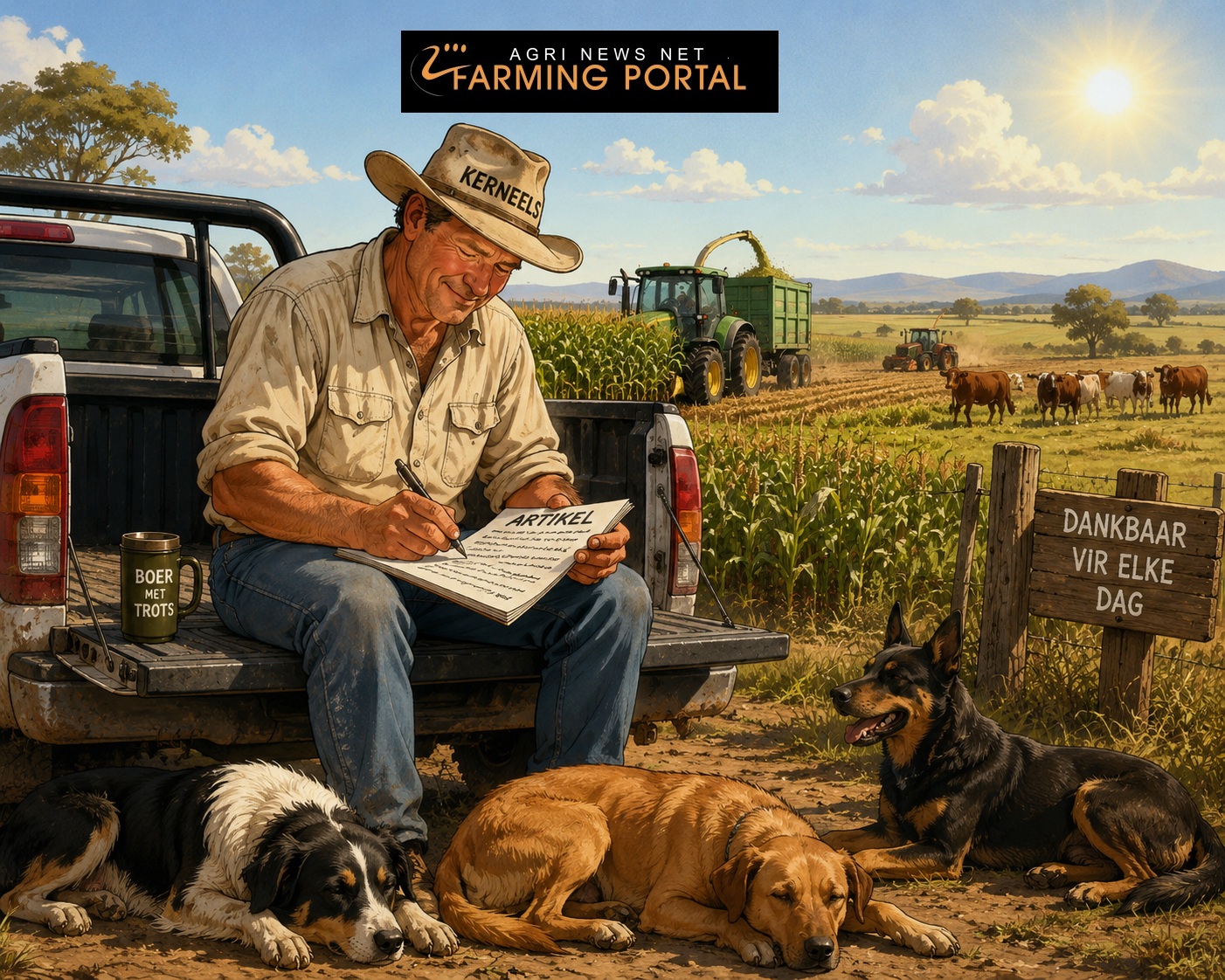
OOM KERNEELS
Van die Plaas af:
Net so koud soos dit verlede week was, net so lekker warm is dit nou hier by ons in die Vrystaat. Die dae is heerlik, maar in die vroeë oggendure trek 'n mens darem nog daai kombers nader.
En toe wen die All Blacks ons Springbokke. Dis 'n groot slag vir baie manne en vrouens se harte wat seeris,maar ja - as jy rugby-mal is, dan moet jy vat wat na jou toe kom. My hart is ook seer.
Ek en Gertruida en die kleinkinders het darem heerlik rugby gekyk op 'n lekker groot skerm. As jy sukkel met jou gehoor dan moet jy na sekere kommentaar luister - daar is 'n man wat kan skree en opgewonde raak! Tot Gertruida, wat bietjie doof is, het gesê ons moet hom sagter sit. Toe skuif ons maar oor na 'n ander kanaal toe, dis darem baie rustiger. Die springbokke het lanklaas sover verloor- maar ek dink daar was dalk so 'n bietjie gevoel by sekere spelers van "untouchable" bespeur. Maar ons is trots op ons bokke. Kyk mooi wat gaan gebeur in Kaapstad.
Die manne met hulle Rugby gesels op 'n Televisie program is net soos klomp klein seuntjies- giggel en lag en is baie sterk met die bier in die hand. Maar daar is ook 'n paar groot legendes wat nog respek het vir televisie en sy kykers. Die aanbieders hou daarvan om die volgende te se. "Julle daar by die huis" is nogal heel onprofessioneel- dis die belangrikste persone.
Soos ek verlede week gesê het, ons is klaar met die oes en nou is ons besig om die lande voor te berei vir die volgende oes. As daai diesel-trok op die plaas aankom, moet jy maar sluk aan wat dit kos - deesdae kos 'n vrag diesel amper die prys van 'n trekker in die tagtigerjare.
Ons het baie ondervog hier in die Vrystaat en ek glo ons gaan nog 'n oes kan deurtrek as die hitte ons net 'n bietjie spaar. Ek sien die slim manne met die dik brille is nou alweer besig met hulle sommetjies en voorspellings,maar ek sê altyd die jong boere moet maar liewer vir hulle Pa luister, want hy het baie meer kennis as die jong geleerdes met hulle boekem en grafieke en APPs.
Ek was nou die dag by 'n kongres en die nuwe tendens is om mense bymekaar te kry op die verhoog met 'n gespreksleier soos by Nampo wat vir ure gesels rondom landbou en hoe om oplossings te kry- gesels is goed- maar dis hoogs verveling, as dit so aanhou, ons boere is doeners en nie praters nie. Die slim manne moet maar iets ander begin uitdink want baie boere voel so- want gewoonlik is dit net die korporatiewe manne wat gesels.
Ek het nou die dag 'n jong man gesien wat geen respek het vir ouer mense nie. Dis sommer "jy en jou" en hy steek sommer sy hand so sit-sit uit, hy staan nie eers op om te groet nie. Dis net hier in die platteland waar daar nog 'n Oom en 'n Tannie is. So verloor die mensdom sy tradisies en maniere hoe meer hulle op die sosiale media is.
Ek het verlede week begin gesels om trekkers te vervang en die manne by die koöperasie is baie opgewonde, maar ek sal maar kyk hoe ek maak. Dalk koop ek 'n heel ander maak trekker.
Mag julle 'n geseënde week hê daar op die plaas en in die dorp.Groete uit die Vrystaat
Die manne met die groot dik brille kom vertel vir ons net wat ons wil hoor .Boer voort, hou kop, en onthou: die mense wat die minste praat, is gewoonlik die wat die meeste werk. Tot volgende week.
Mag julle almal ’n lekker week he ons gesels weer. OOM Kerneels.

NS -We normally do not post sponsored or external videos on our professional platforms. However, videos of this nature — which are non-marketing and informative — are not freely available YouTube channels. We will soon have our own Professional Video Channel form our own Production house.